

Adobe Commerce Migration
Move to Adobe Commerce without gambling with your catalog
Years of order history, layered pricing rules, and custom modules nobody fully documented, that is what a legacy Magento store carries, and what a careless migration can quietly drop. We move stores onto Adobe Commerce or Magento Open Source from Magento 1, an aging 2.x build, or another platform, and reconcile every record after transfer so nothing is lost.
- Full catalog, customer, and order data migration
- SEO equity and URL structure preserved
- Rehearsed, monitored cutover with a rollback plan
Migration Overview
A migration is a rebuild, staged around a live catalog
Moving to Adobe Commerce means re-creating your catalog, customers, and order history on current, supported infrastructure, not copying files onto a new server.
What is an Adobe Commerce migration?
An Adobe Commerce migration is the structured move of a store from Magento 1, an aging Magento 2 build, Magento Open Source, or another platform onto a current Adobe Commerce or Magento Open Source installation. It covers catalog, customer, and order data transfer, custom module review, SEO and URL preservation through redirects, and a rehearsed cutover, rather than a direct lift of the old store's files onto new hosting.
Catalog structure, custom modules, and integrations rarely map cleanly between an old build and a current one. A useful migration plan accounts for where they differ before development starts, not after data has already moved.
Migration is also the moment to choose the right edition deliberately. See our Adobe Commerce development page for the platform work that follows a migration, custom modules, integrations, and ongoing iteration.
Why Brands Migrate
Common reasons stores move to Adobe Commerce
A migration is usually triggered by a specific, recognizable pressure, not a vague desire for something new.
Magento 1 End Of Life
No security patches means every month on Magento 1 is measured risk, not stability.
Accumulated Technical Debt
Years of undocumented customization have made the current build fragile to touch.
Licensing Or Edition Mismatch
The current edition no longer matches the catalog, team, or budget it needs to serve.
Slow Storefront Performance
Page speed and Core Web Vitals lag behind what current infrastructure could deliver.
B2B And Wholesale Needs
Company accounts and contract pricing are outgrowing what the current build supports.
Vendor Dependency
Every change requires a specialist who understands an increasingly unusual build.
Checkout Limitations
The current build cannot support the payment methods or checkout UX customers expect.
Scaling Constraints
Traffic, catalog size, or order volume are approaching what the architecture was built for.
What A Migration Covers
Six areas of an Adobe Commerce migration
Every project is scoped to the store's own data and complexity, not a fixed package.
Core Data
Catalog & Product Data Migration
Products, attributes, categories, media, and pricing rules transfer and get reconciled, so the catalog lands complete and merchandising stays intact.
- Products, variants, and configurable attributes
- Categories and merchandising structure
- Media and digital assets
- Pricing rules and catalog price books
- Post-transfer reconciliation against the source store
Account History
Customer & Order History Transfer
Customer accounts, addresses, and full order history carry across, so returning shoppers log in to the store they remember and records stay complete.
- Customer accounts and saved addresses
- Full order history and status
- Stored payment preferences where supported
- Wishlist and account-level data
Organic Visibility
SEO Equity & URL Preservation
Mapped 301 redirects, preserved URL structure, metadata, and structured data, so rankings built over years survive the move instead of resetting.
- Full URL mapping with 301 redirects
- Preserved URL structure where possible
- Metadata and structured data migration
- Post-launch indexing and ranking monitoring
Storefront
Theme Rebuild & UX Modernization
A migration is the right moment to leave a dated front end behind rather than recreate its limitations on new infrastructure.
- Modern, conversion-aware theme selection or custom build
- Mobile-first responsive layout
- Category and product page structure review
- Design-to-development handoff for custom sections
Considering a leaner Magento frontend instead? Explore Hyvä Theme Development →
Connected Systems
ERP, PIM & Systems Integration
Adobe Commerce gets reconnected to ERP, PIM, and fulfillment systems, so inventory, orders, and pricing keep flowing from the day the new store goes live.
- ERP and PIM reconnection
- Fulfillment and shipping system sync
- Payment gateway and tax configuration
- Custom middleware where no ready-made connector exists
Need deeper integration work beyond the migration itself? Explore Magento Integrations →
Go-Live
Staged Testing & Rehearsed Cutover
The new store runs in parallel with the old one, gets tested under realistic load, and only goes live through a planned, monitored cutover with a rollback path.
- Parallel environment for final reconciliation
- Checkout and payment testing under load
- Documented rollback plan before go-live
- Monitored launch window with immediate verification
Choosing The Destination
Migrate to Adobe Commerce, or to Open Source?
A migration is the moment to choose the edition deliberately, not inherit whichever one the store happened to start on.
For teams that want control, no license
A strong fit for stores leaving Magento 1 on a defined budget: a clean, self-hosted rebuild with custom modules covering anything the licensed edition would otherwise provide.
- Leaving Magento 1 on a defined budget
- Want a clean, license-free rebuild
- Team will own the platform after launch
For B2B, scale, and a managed SLA
The right destination when native B2B, advanced merchandising, and a vendor-backed SLA are worth the license, on-premise or on Adobe Commerce Cloud.
- Need native B2B from day one
- Managed Cloud infrastructure and an SLA matter
- Scaling past what Open Source comfortably fits
Not sure which edition fits? A migration audit maps the right destination before any data moves. Book a Free Consultation →
Migration Process
A clear path from audit to a rehearsed launch
The same four stages apply regardless of the source platform.
Audit
Inventory the current store: catalog, customizations, integrations, and the URLs driving traffic.
Output: Migration scopePlan
A phased roadmap with scope, timeline, a redirect map, and a data plan, before any code is written.
Output: Migration roadmapMigrate
Rebuild on Adobe Commerce or Open Source, transfer and reconcile data, and run the store in parallel.
Output: Parallel environmentLaunch & Grow
A rehearsed cutover with monitoring and a rollback plan, then post-launch tuning and support.
Output: Live store, monitoredEngagement Models
Ways to scope an Adobe Commerce migration
Scope, timeline, and cost are agreed around the actual store and data involved, not a fixed package. No invented prices are shown here.
Migration Assessment
Audit the current store and produce a scoped migration plan before committing to the full project.
Fixed-Scope Migration
A defined source-to-target move with agreed data scope, timeline, and go-live plan.
Phased Migration Program
Sequence a larger catalog, complex integrations, or multi-store migration across controlled stages.
Migration Plus Support
Migration paired with ongoing post-launch monitoring, fixes, and iteration.
Selected Work
Real Magento and Adobe Commerce delivery
Only genuinely matching, currently published work is shown here. This is real Magento delivery proof; it is not confirmed as an Adobe Commerce migration specifically, and nothing beyond what is in the published case study is claimed.
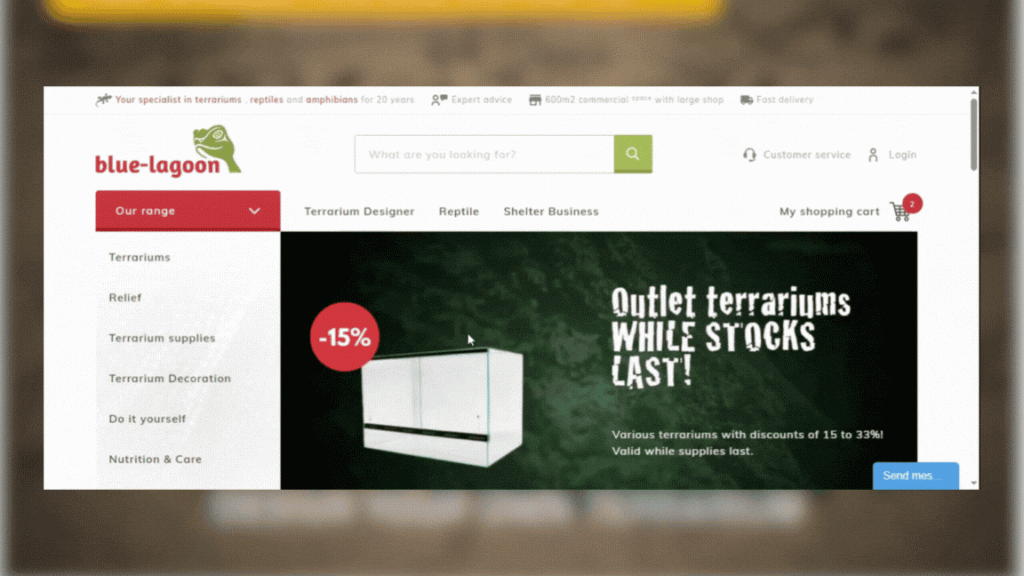
Blue Lagoon
Magento eCommerce delivery for a Netherlands-based reptile retailer, focused on smoother catalog discovery, safer storefront operations, and a clearer checkout experience.
- Smoother catalog discovery
- Safer storefront operations
- Clearer checkout experience
iThis project is published under Ethnic Infotech's Magento work; it is not documented as an Adobe Commerce migration specifically.
Why Ethnic?
A migration treated as a rebuild, not a shortcut
We connect data integrity, SEO continuity, systems reconnection, and a rehearsed cutover into one accountable process.
- Structured, reconciled data migration, not a raw import
- SEO and URL preservation built into the plan from day one
- Honest guidance on Adobe Commerce versus Open Source
- Rehearsed cutover with a documented rollback plan
- ERP and PIM reconnection scoped from the start
- Post-launch support available once the store is live
Related Services
Connect migration with the wider Adobe Commerce roadmap
Use migration findings to plan the platform, architecture, or support work that follows.
Frequently Asked Questions
Adobe Commerce migration FAQs
Direct answers about SEO, platform source, downtime, and scope.
Will an Adobe Commerce migration hurt my search rankings?
Not when it is planned properly. We map every existing URL to its new destination with 301 redirects, preserve metadata and structured data, and monitor rankings after launch. The goal is for organic traffic to hold steady through the move.
Can you migrate from Magento 1 to Adobe Commerce?
Yes, and it is one of the most common migrations we run. Magento 1 is end of life with no security support, so moving off it removes real risk. Catalog, customers, orders, and SEO equity carry across, and existing customizations are rebuilt to current standards.
What data actually carries over in a migration?
Products, attributes, categories, media, and pricing rules; customer accounts, addresses, and full order history; CMS and blog content; your URL and redirect structure; plus reconnected ERP, PIM, and fulfillment integrations.
Can you migrate to Adobe Commerce from a platform other than Magento?
Yes. We migrate stores onto Adobe Commerce or Magento Open Source from Magento 1, Magento Open Source, and other ecommerce platforms. The approach stays the same: audit, map data and URLs, rebuild, run in parallel, then cut over.
Should we migrate to Adobe Commerce or Magento Open Source?
Open Source suits a clean, license-free rebuild for teams that will own the platform themselves. Adobe Commerce is the right destination when native B2B, advanced merchandising, and a managed SLA are worth the license. We help decide during the migration audit.
How do you avoid downtime during the cutover?
The new store is built and tested in parallel with the existing one, and the cutover itself is rehearsed beforehand. The actual switch is a planned, monitored event with a rollback plan in place.
How long does an Adobe Commerce migration take?
Timeline depends on catalog size, source platform, custom modules, and integration count. A realistic timeline is set after the audit, not before it.
Do you provide support after the migration goes live?
Yes. Post-launch support can cover monitoring, incident fixes, and planned iteration once the store is live.
Plan Your Migration
Move to Adobe Commerce without losing what you built
Tell us where your store runs today and where it needs to go. We will scope a real migration plan around your catalog, data, and timeline.