

Magento Headless Development
Magento Headless Development Services
We build custom storefronts on top of Magento Open Source and Adobe Commerce, so your catalog, pricing, and orders keep running in Magento while the customer experience is engineered separately.
- Custom storefronts on Magento's GraphQL API
- GraphCommerce, Edge Delivery Services, or your own stack
- Magento keeps the catalog, pricing, and orders
A custom frontend reads from and writes to Magento through its GraphQL API.
Service Overview
Magento headless development for brands that need more than a theme can give.
We design and build custom storefronts that use Magento or Adobe Commerce as the commerce engine, from architecture and storefront choice to launch and long-term support.
A Magento theme keeps the storefront and the commerce engine in one codebase, which is simple to run and, for many stores, the right answer. When the experience you need goes beyond what a theme can deliver, a headless storefront runs as its own application and talks to Magento through its GraphQL API, while Magento keeps managing the catalog, pricing, customers, and orders.
Our team handles the full path: deciding whether headless fits, choosing the storefront approach, building and integrating it, planning checkout and payments, and supporting the result after launch.
Custom storefront experiences
Layout, content, and interaction designed around your brand instead of theme templates.
Magento as the commerce engine
Catalog, pricing, promotions, customers, and orders continue to be managed in Magento.
An approach chosen for you
Edge Delivery Services, GraphCommerce, or your own stack, picked for your edition and team.
Headless Versus Traditional
Headless Magento versus a traditional Magento storefront.
Neither is better in every case. They trade simplicity for control.
Traditional Magento storefront
The storefront is rendered by a Magento theme, in the same codebase and deployment as the commerce engine.
- Advantage: One codebase to deploy
- Advantage: Extensions can add storefront UI directly
- Advantage: Usually faster to launch
- Trade-off: Limited by what the theme supports
Headless Magento storefront
The storefront is a separate application that talks to Magento through its GraphQL API.
- Advantage: Storefront released independently
- Advantage: Full control of design and content
- Trade-off: Extensions that add storefront UI need an API-based replacement
- Trade-off: More moving parts to own
We help you decide with the trade-offs in view, including when a faster theme such as Hyva is the better step. See Hyva Theme Development.
How It Works
What headless Magento means, in plain terms.
The storefront becomes its own application, and Magento stays behind it.
In a headless build, Magento keeps doing what it does best: managing products, prices, promotions, customer accounts, and orders. A separate storefront application reads that data and sends actions back, such as adding to cart or placing an order, through Magento's GraphQL API.
Adobe documents the core Adobe Commerce GraphQL APIs, and its newer storefront services add further APIs for storefront features. Which APIs a project uses depends on the storefront approach and your Magento edition.
Magento Headless Model
Magento stays the commerce engine
Products, pricing, promotions, customers, and orders continue to be managed in Magento.
GraphQL connects the layers
The storefront queries and updates Magento through its GraphQL API instead of through theme code.
Your storefront is its own application
Layout, content, and interaction are not limited to theme templates, and the storefront can be released on its own.
Checkout and payments are planned deliberately
The storefront builds the checkout experience on Magento's APIs, so payment methods need to be supported on purpose, not assumed.
Storefront Options
Four ways to build a headless Magento storefront.
The right one depends on your Magento edition, your team, your hosting preferences, and how much of the stack you want to own.
We recommend an approach based on your situation, not a preference. Adobe's own guidance names Edge Delivery Services as its recommended starting point, and its drop-in components have licensing requirements that depend on your Adobe Commerce offering, so we confirm what applies to you during discovery.
When To Consider It
When headless Magento becomes the right choice.
Headless is worth the extra engineering when one or more of these situations describes your store.
Custom Design Requirements
You have layout, navigation, or interaction requirements that a Magento theme cannot deliver, so the storefront has to be designed and built as its own application.
How we help: We turn your design direction into a storefront on GraphCommerce, Edge Delivery Services, or your own framework.
Scalability
Traffic or catalog size is growing, and you want to scale the storefront layer on its own hosting and caching, separately from the Magento backend.
How we help: We plan hosting, caching, and rendering for the storefront and keep the commerce engine in Magento.
Integration With Third-Party Tools
You rely on several systems, such as ERP, CRM, search, or content tools, and want them connected through APIs rather than through more extensions.
How we help: We design the API connections in the architecture phase and confirm what each system needs before building.
Mobile Optimization
Mobile shoppers are a large part of your audience, and you want a mobile experience that is designed and tuned deliberately instead of adapted from a desktop-first theme.
How we help: We plan mobile journeys and performance from the start, and test them before launch.
Content-Led Commerce
Editorial content, campaigns, and brand storytelling play a large role in how customers decide what to buy.
How we help: We connect a content layer to the storefront, so your team can publish alongside products.
Modernizing an Older Storefront
Your storefront still runs on an older theme, and you want to modernize the experience without replacing the Magento backend.
How we help: We assess the current storefront and extensions, then plan a staged move to a headless frontend.
Honest Scoping
When headless Magento may not be the right fit.
A headless storefront is a custom application, so it carries more engineering and ongoing ownership than a theme. We would rather say so early than sell an architecture a business does not need.
A faster theme already solves it
If the goal is speed and a cleaner frontend, a performance-focused theme such as Hyva keeps Magento's own rendering and is often the simpler first step. See Hyva Theme Development.
Heavy reliance on storefront extensions
Extensions that add storefront UI through the theme will not carry over by themselves. Each needs an API-based replacement or custom work.
Limited engineering capacity
A custom storefront is an application you maintain, alongside the Magento backend. Someone needs to own both.
A tight launch window or budget
Headless usually asks for more design and engineering up front than theme work.
A standard payment setup you cannot change
The storefront builds checkout on Magento's APIs. Adobe's PWA Studio documentation notes that payment methods beyond its defaults need extra implementation, so plan for it.
A backend that is out of support
Headless does not replace upgrades. Adobe publishes support dates for each version, and the Magento backend still needs to stay on a supported one.
We say this early in discovery. If a lighter option fits your goals better, we will recommend it.
Benefits
Benefits of Magento headless development, and what each one depends on.
These are possibilities a well-planned build can unlock, not guarantees. Headless also adds cost and responsibility, which is why we scope it honestly.
Design Flexibility
Layout, navigation, and interaction are designed around your brand and customer journeys instead of adapted from a Magento theme.
Performance Control
You control how pages are rendered, cached, and delivered. Built and hosted well, that can support faster loading and smoother browsing.
Independent Storefront Releases
Storefront changes ship on their own release cycle, without redeploying Magento. A first build usually takes longer than a theme, so the gain comes after launch.
A Smaller Upgrade Surface
The storefront talks to Magento through GraphQL instead of theme code, so there is less frontend code tied to each Magento upgrade. Upgrades still need testing.
Composable Integrations
Search, content, and business systems connect through APIs, which can mean fewer extensions competing inside the Magento core.
Content and Commerce Together
Editorial and campaign content can sit alongside products, through a content layer or, with Adobe's storefront, document-based authoring.
Multi-channel Reuse
The same Magento catalog and orders can power the web, mobile apps, and other touchpoints through its APIs.
Modern Developer Experience
Engineers work in current frameworks and tooling, such as Next.js and React, with their normal development workflow.
Composable Commerce
Headless Magento and the MACH approach, explained.
MACH stands for Microservices-based, API-first, Cloud-native SaaS, and Headless, a framework promoted by the MACH Alliance. Headless is the H.
A standard Magento or Adobe Commerce installation is not itself a set of microservices or a SaaS product, so a headless storefront does not make a store MACH by itself. It does open the door to composable thinking: adding capabilities such as search or content as separate services instead of more extensions in the core. You do not need all four principles to benefit, and we adopt only what fits your business.
Microservices-based
Add capabilities as separate services rather than as more extensions inside Magento.
API-first
Magento's GraphQL APIs become the contract between the storefront and the commerce engine.
Cloud-native
Host the storefront on cloud or edge infrastructure and scale it independently of the backend.
Headless
The storefront is its own application, designed and released separately.
What We Deliver
Headless Magento services, from architecture to long-term support.
Our team covers the full path, from deciding whether headless fits to running the storefront after launch.
Headless architecture and storefront choice
Decide whether headless fits, choose between Edge Delivery Services, GraphCommerce, and a custom storefront, and plan how the pieces connect before any build starts.
Custom storefront development
Storefronts built on your chosen approach, around your catalog, content, and customer journeys.
GraphQL integration and extension
Connect the storefront to Magento's GraphQL API, and extend it where a storefront feature needs data the standard API does not provide.
Migration from a theme to headless
Move an existing Magento storefront to a headless frontend while the commerce backend keeps running, as in our Tong Garden project.
Checkout, payments, and content layer
Plan and build checkout and payment support on Magento's APIs, and bring content and search into the storefront.
Hosting, deployment, and ongoing support
Deployment pipelines and hosting for the storefront, plus monitoring and upkeep. See CI/CD Pipeline Setup and Magento Support Services.
Integrations
Integrations that connect a headless Magento storefront to the rest of your business.
Because a headless storefront talks to other systems through APIs, integrations are planned in the architecture phase instead of added at the end.
Payments and checkout
Payment methods and checkout steps supported in the storefront and connected to the Magento order.
- Payments
- Checkout
- Order status
Shipping and fulfilment
Delivery options and order handoff connected to the way you fulfil orders.
- Rates and tracking
- Order handoff
ERP and inventory
Stock levels, pricing, and orders kept aligned between Magento and back-office systems.
- Stock levels
- Order sync
CRM and customer data
Customer records and segments available to the storefront and your sales and service teams.
- Customer records
- Segments
PIM and product content
Product data and media managed in one place and delivered to the storefront.
- Product data
- Media
Search, content, and marketing
Capabilities that extensions or theme code often provide, rebuilt as services for a headless storefront.
- Search
- Content
- Analytics
For platform-specific integration work, see Magento Integrations and Adobe Commerce Integrations.
Migration Path
A typical path from a Magento theme to a headless storefront.
Most migrations rebuild the storefront while the Magento backend stays in place. The exact steps vary by store and scope.
Assess the current store
Review the Magento version and support status, the theme, the extensions in use, and what the storefront needs that a theme cannot give.
Choose the approach
Decide between Edge Delivery Services, GraphCommerce, and a custom storefront, and plan the architecture, content layer, and hosting.
Build on the GraphQL API
Design and build the storefront against your existing Magento backend, shaped around your journeys and content.
Rebuild what the theme and extensions did
Recreate payments, search, content, and any storefront features that lived in theme code or extensions.
Test what matters
Test cart to order, payment methods, redirects from old URLs, SEO basics, and performance before anything goes live.
Launch and support
Cut over, monitor, and keep both the storefront and the Magento backend current.
Case Study
Headless Magento in practice: the Tong Garden storefront.
One of our headless projects, described with the scope we actually delivered.
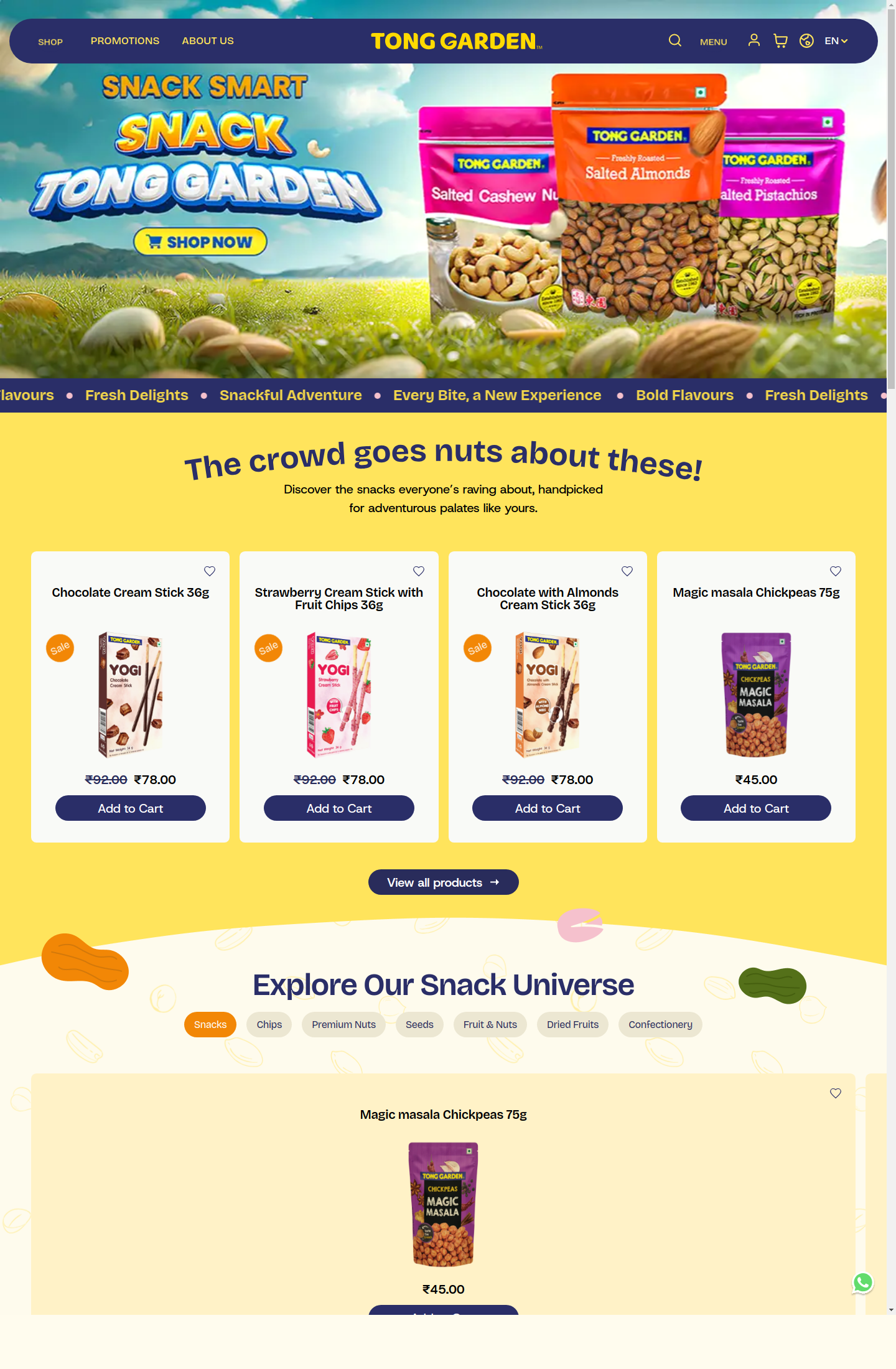
Tong Garden: from a Magento-led storefront to GraphCommerce
The project. Tong Garden's India storefront was moved from a Magento-led storefront layer to GraphCommerce, while Magento continued to run the underlying commerce engine.
Our role. Ethnic Infotech handled the technical migration and storefront implementation, in partnership with Thirteen Ideation, which led the brand and design direction.
The goals.
- Faster storefront speed
- A smoother buying journey
- Less frontend complexity
- Stronger conversion support
Why Choose Us
Why brands choose our Magento headless development team.
- Delivery history we can point to: a headless Magento storefront (Tong Garden), described with the scope we delivered, alongside Magento and Adobe Commerce projects across retail.
- Experience across the full stack, Next.js, React, GraphQL, and commerce backends including Adobe Commerce, Magento, and Shopify.
- Honest scoping: we say when headless is not the right fit, not just when it is.
- Long-term partnership: the team that builds the storefront also maintains it.
Engagement Models
Ways to work with our Magento headless development team.
Dedicated Team
Hire Magento headless developers on a dedicated, ongoing basis for continuous delivery.
Fixed-Scope Project
A defined scope, timeline, and budget for a specific storefront build or migration.
Staff Augmentation
Add frontend and API-integration engineers into your existing in-house team.
For Magento developers more broadly, see Magento Development.
FAQs
Magento headless development FAQs
What is headless Magento?
A Magento or Adobe Commerce store whose storefront is a separate application. Magento keeps managing the catalog, pricing, customers, and orders, and the storefront connects to it through its GraphQL API. See the How It Works section above.
Does headless work with both Magento Open Source and Adobe Commerce?
Yes, with different options. GraphCommerce supports both. Adobe documents its drop-in components as included with Adobe Commerce as a Cloud Service or Adobe Commerce Optimizer, and says Adobe Commerce on Cloud needs a separate Optimizer license to use them. We confirm what applies to your edition during discovery.
Which storefront option should we choose?
It depends on your edition, team, hosting preferences, and goals. Adobe names Edge Delivery Services as its recommended starting point, GraphCommerce is an open-source React and Next.js option, and a custom storefront gives full control. See the Storefront Options section above.
Will our Magento extensions still work?
Not always. Extensions that work in the backend, such as admin and order processing, keep running in Magento. Extensions that add storefront UI through the theme need an API-based replacement or custom work. We review your extensions during discovery.
How do checkout and payments work?
The storefront builds the checkout experience on Magento's APIs, and Magento still manages the order. Each payment method has to be supported in the storefront. Adobe's PWA Studio documentation notes that methods beyond its defaults need extra implementation, so we confirm your payment methods early.
Is headless good for SEO?
It can be, but it is not automatic. Search visibility depends on how pages are rendered and delivered, and on keeping URLs, content, and metadata intact, including redirects from old URLs. We plan this into the migration from the start. See the Migration Path section above.
How long does it take, and what does it cost?
Both depend on catalog size, design scope, integrations, and how much of the current storefront is being rebuilt. A headless storefront is usually a larger investment than theme work because it is a custom application. We confirm a timeline and scope after discovery rather than quoting figures up front. See the Engagement Models section above.
Can you go headless without replacing our Magento backend?
Often, yes. In a typical migration the Magento backend stays in place and the storefront layer is rebuilt. That is how our Tong Garden project worked: the storefront moved to GraphCommerce while Magento continued as the backend. Read the Tong Garden case study.
Should we choose headless or Hyva?
Hyva is a lighter frontend option that keeps Magento's own rendering, while headless gives more freedom and adds more complexity. The better fit depends on how much frontend control and multi-channel flexibility you need. See the When It May Not Be the Right Fit section above, or Hyva Theme Development.
Do you support the storefront after launch?
Yes, including monitoring, integration maintenance, and keeping the storefront compatible as Magento changes. Adobe publishes support dates for each Adobe Commerce version, so the backend needs to stay on a supported one. See Magento Support Services.
Ready to Talk
Planning for a headless Magento storefront, a storefront approach decision, and a migration from your current theme.
Considering a Headless Magento Storefront?
Talk through whether headless fits your Magento store, which storefront approach suits your edition and team, and what a migration from your current theme would involve.
- A headless fit assessment before any build
- Edge Delivery Services, GraphCommerce, or your own stack
- Migration planned around SEO, extensions, and payments