
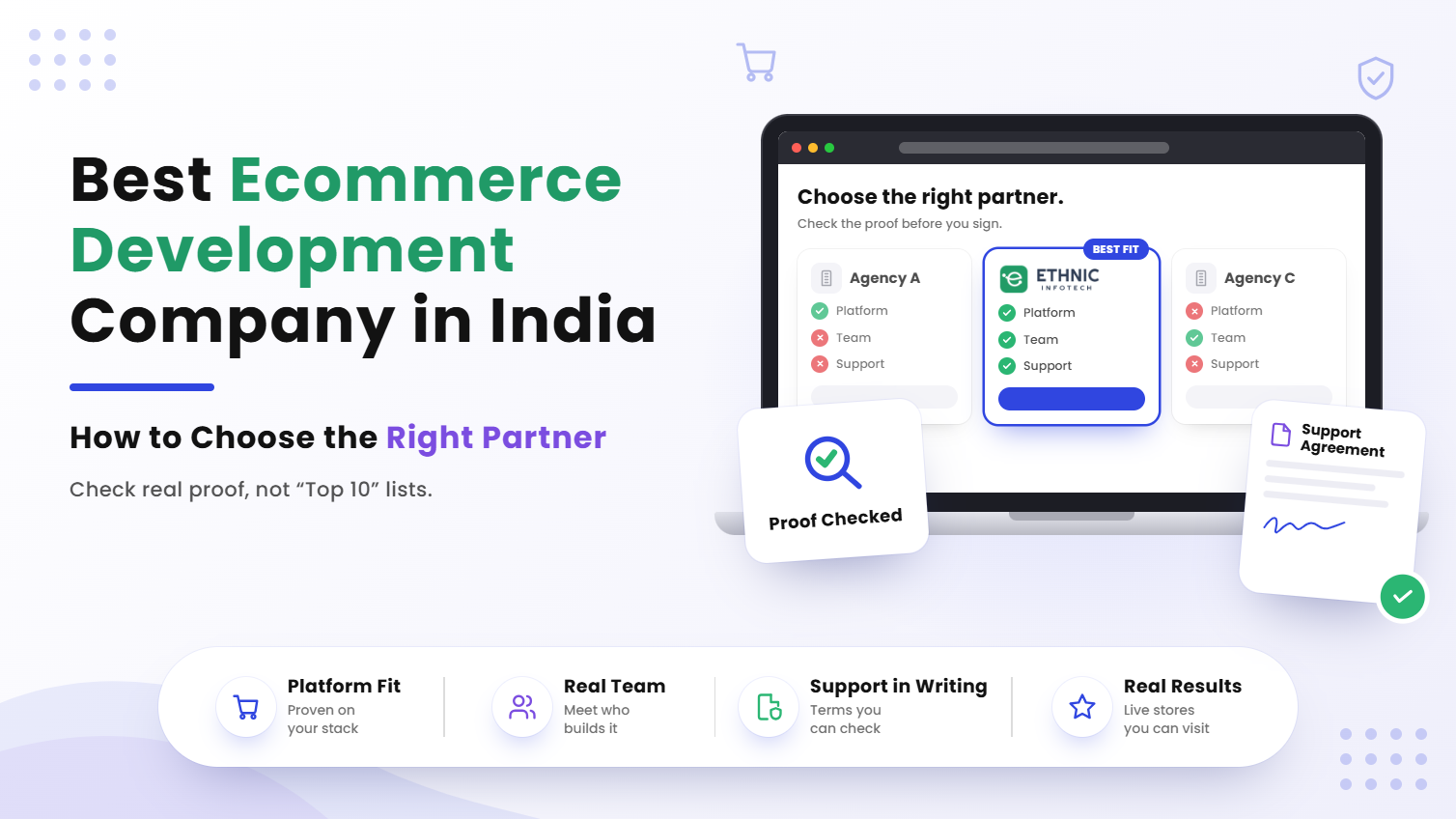
The best ecommerce development company in India is not the one at the top of a “Top 10” list. It’s the one that has shipped stores on your platform, can show you the people who will actually build yours, and puts its post-launch support terms in writing. Check those three things with real client references and you’ll avoid most bad outcomes, whatever country the agency is in.
Why “Best” Is the Wrong Starting Point
Search this phrase and you’ll mostly find lists written by agencies that put themselves in first place. That isn’t a criticism, it’s just how the format works. But it means the word “best” has been emptied of meaning before you even start.
A more useful question: best for what? A D2C brand moving off a cluttered Shopify theme needs something very different from a B2B distributor with 40,000 SKUs and contract pricing. The agency that suits one can be a poor fit for the other.
India also has a lot of agencies to choose from. The GoodFirms directory of ecommerce development companies in India says it has reviewed 6,268 of them. And the wider industry is large and mature: the NASSCOM Strategic Review 2026 executive summary puts India’s technology industry revenue at $315 billion, with nearly 6 million people employed. Depth of talent isn’t the problem. Filtering is.
Platform Depth vs the “We Do Everything” Agency
Here’s the first filter. Look at the services page. If an agency lists 40 or more services, from blockchain and game development to SEO, logo design and every ecommerce platform ever released, ask yourself how deep any one of those practices can really be.
Ecommerce platforms reward specialists. Shopify Plus has its own checkout extensibility rules, app ecosystem and B2B features. Adobe Commerce (Magento) has a complex codebase, indexing, caching and extension conflicts that take years to learn properly. Headless builds add a separate front end (GraphCommerce, Shopify Hydrogen or a custom React or Next.js layer) talking to the commerce backend through APIs. Doing all three well is already a serious commitment.
A focused team will usually:
- Talk about your catalog, integrations and checkout before they talk about design.
- Tell you when a platform is the wrong fit, even if it costs them the bigger project.
- Show case studies on the exact platform you’re considering.
A generalist shop is not automatically bad. But if ecommerce is one tab among dozens, push harder on proof.
In-House Delivery vs Quiet Subcontracting
This is the risk most buyers never ask about. Some agencies win the contract, then pass the build to a freelancer or a white-label partner without telling you. You meet a polished sales lead and a project manager. You never meet the developers.
Subcontracting is not always wrong. Specialist partnerships are normal, and good agencies disclose them openly. The problem is quiet subcontracting, where you can’t see who holds your code, who has your admin credentials, or who to call when a release breaks checkout on a Friday.
| Factor | Direct, in-house delivery team | Quietly subcontracted delivery |
|---|---|---|
| Who builds your store | Named developers you can meet on calls | Unknown freelancers or a third-party shop |
| Knowledge retention | Stays with the team that supports you | Leaves when the subcontractor moves on |
| Accountability | One team owns the result | Blame moves between parties |
| Access and security | You know who holds credentials | Credentials pass through more hands |
| Post-launch fixes | Same people who wrote the code | Often a new person learning the codebase |
| Partner disclosure | Partners named in the proposal | Partners hidden or denied |
Evaluation Criteria That Actually Predict a Good Outcome
Most agency directories rank on client feedback first. Clutch’s explanation of its ranking factors describes verified client reviews as the most heavily weighted part of its Ability to Deliver score. That’s a good instinct. Here’s how to apply the same thinking in your own process.
1. Case Studies in a Similar Industry and Platform
A beautiful fashion store doesn’t prove an agency can handle a parts catalog with year, make and model filtering. Look for case studies that match your platform, your catalog complexity and, ideally, your business model.
Questions to ask about each case study
- Which platform and version was this built on, and is it still live?
- What exactly did your team build, and what did the client or another partner build?
- Can I speak to someone at this client?
- What went wrong during the project, and how did you handle it?
Be wary of case studies that are all adjectives (“seamless”, “robust”, “world-class”) and no specifics. Specific, checkable details are worth more than big numbers you can’t verify.
2. The People Who Pitch Are the People Who Build
Ask directly: “Who will work on my project day to day?” Then ask to meet them before you sign. A senior developer or technical lead should join at least one pre-sales call.
Questions to ask about the team
- Are these developers full-time employees or contractors?
- Will any part of the work be subcontracted? If so, to whom?
- Who is my single point of contact, and who covers when they’re away?
- How long has the proposed lead developer worked on this platform?
3. Post-Launch Support Terms in Writing
Launch day is the start, not the finish. Patches, app updates, Core Web Vitals regressions and peak-season traffic all show up after go-live.
Speed problems also cost real money. In Google’s web.dev case study on Vodafone, an A/B test on a landing page showed that a 31% improvement in Largest Contentful Paint led to 8% more sales. You want a partner who keeps watching performance after launch, not one who disappears.
What the support agreement should cover
- Warranty period for defects after launch, and what counts as a defect.
- Response times by severity (for example, checkout down vs a styling bug).
- Who applies security patches and platform upgrades, and how often.
- Monthly hours or retainer options, and the rate for work outside them.
4. Code Ownership, Access and Documentation
You should own your code, your repository and your accounts. Full stop.
Ownership checklist
- The contract assigns IP for custom code to you on payment.
- The Git repository lives in your organization’s account, or is handed over in full.
- You hold admin access to the platform, hosting, domain and key apps.
- Handover documentation covers custom modules, integrations and deployment steps.
5. Communication and Process
Look for a written process: discovery, scoping, sprint cadence, staging reviews, QA sign-off and launch checklist. Ask which tools they use for tickets and updates, and how often you’ll get a demo of working software.
The Fear About Outsourcing to India, Addressed Honestly
Let’s be direct. Quality varies a lot between Indian agencies. Some are excellent, some are average, and some are not ones you want to hire. The same is true in the UK, the US and Australia.
The country isn’t the variable that predicts your outcome. The agency is. That’s why the fix is checking real client references and seeing working stores, not avoiding a whole market.
Buyers are also moving past pure cost as the reason to outsource. Deloitte’s 2024 Global Outsourcing Survey, based on more than 500 executives, found that skilled talent and agility now sit alongside cost reduction as key drivers, and that 80% of executives plan to maintain or increase their outsourcing investment. Clutch’s survey of 312 US-based B2B buyers points the same way: understanding of the buyer’s specific business needs (29%) and the ability to provide the service (28%) were the two biggest deciding factors.
In plain terms: buyers who do well choose on fit and capability, then verify both.
How to check a reference properly
- Ask the agency for two or three clients from the last 18 months, ideally on your platform.
- Contact them yourself (LinkedIn works) rather than relying only on quotes on the agency site.
- Ask what the agency did when something went wrong, and whether they would hire them again.
A Practical Shortlisting Checklist
Use this before you book any calls.
- Platform match: At least one case study on your platform (Shopify Plus, Adobe Commerce or headless).
- Focus: Ecommerce is a core practice, not one item on a long list.
- Team visibility: You’ve met the lead developer, not just sales.
- Subcontracting disclosed: Any partners are named in writing.
- References: At least two client conversations you arranged yourself.
- Written proposal: Scoped against the same requirements document you sent everyone.
- Ownership: IP, repository and admin access stay with you.
- Support terms: Warranty, response times and patching responsibilities in writing.
- Working overlap: An agreed daily window for calls with your time zone.
- Process: Sprint cadence, staging environment and QA sign-off defined up front.
Red Flags to Watch For
- A price before any questions. If you get a number before anyone asks about your catalog, integrations or traffic, the number is a guess.
- “We can do anything.” Every platform, every service, no clear focus.
- No developer on calls. Only sales and account managers, ever.
- Vague or unverifiable proof. Big percentages with no client name, link or way to check.
- Reluctance to share references. Or references that only exist as quotes on their own site.
- Code held hostage. Repository in the agency’s account with no handover clause.
- Pressure to sign fast. Discounts that expire in 48 hours are a sales tactic, not a partnership.
Where Ethnic Infotech Fits
We’re an ecommerce development company based in Surat, India. We work as a remote team serving international clients, and we don’t have local offices abroad. Our focus is narrow on purpose: Shopify and Shopify Plus, Adobe Commerce and Magento, and headless commerce, delivered by the same direct team from kickoff to launch.
Here’s what that looks like in published work. Every example below is on our live case studies hub.
- Tong Garden headless commerce case study: The storefront was replatformed from Magento to a GraphCommerce headless front end, with Magento kept as the backend. We did this in partnership with Thirteen Ideation, and we say so openly. That is the kind of disclosure you should expect from any agency.
- Fusion5 Magento modernization case study: A technology and electronics brand that needed better product discovery, advanced filtering and retail plus wholesale pricing support. The answer was to modernize Magento rather than replatform.
- Blue Lagoon Magento case study: A Netherlands-based reptile retailer. The work focused on catalog clarity, Offbiz data migration and a smoother checkout.
- GoodBac Shopify case study: A UK-based personalized probiotic brand. The Shopify experience includes a custom quiz to help customers find their blend.
- Zolamod Shopify case study: A Shopify store for a tabletop-gaming furniture brand, built around modular gaming tables, premium product storytelling and a flexible buying journey.
We’d rather you judge us the way this guide suggests. Ask to meet the developers. Ask for references. Compare our written proposal against the others line by line. If you’re still weighing up platforms, our guides on Shopify Plus vs headless commerce and choosing the best ecommerce platform are a good place to start. Planning a move? Read the ecommerce replatforming guide. You can also learn more about our team and how we started.
Ready to Talk Through Your Project?
See our case studies across Shopify Plus, Adobe Commerce, and headless commerce, then book a free call to talk through your project.
Browse our ecommerce case studies | Book a free call with our team
Frequently Asked Questions
Is it safe to outsource ecommerce development to a company in India?
Yes, when you vet the agency properly. Check real client references, ask who will actually work on your project, and confirm code ownership and communication practices before signing anything. Make sure the repository and admin access stay in your name from day one.
How do I compare ecommerce development companies fairly?
Ask each one for a written, scoped proposal based on the same requirements document, so you’re comparing like for like instead of comparing vague verbal estimates. Line up the scope, assumptions, exclusions, timeline and support terms in a simple spreadsheet before you look at price.
Do time zone differences cause delays with Indian development teams?
Not typically with an established process. Most international clients maintain a working overlap window for calls, and asynchronous updates cover the rest. Agree the overlap hours, the update channel and the response times in the proposal so nobody has to guess.
How much does it cost to hire an ecommerce development company in India?
It depends on the platform, catalog size, integrations and design scope, so any figure given before scoping is a guess. Rather than trust published rate tables, send the same requirements document to three or four agencies and compare their written quotes. Also budget for platform fees, apps and post-launch support, not just the build.
Who owns the code when an agency builds my store?
You should. The contract should assign intellectual property for custom code to you on payment, and the repository should sit in your account or be fully handed over. Confirm this in writing, along with admin access to the platform, hosting and domain.
Should I choose Shopify Plus or Adobe Commerce?
Shopify Plus usually suits D2C brands that want speed to launch, lower maintenance and a smaller engineering footprint. Adobe Commerce (Magento) tends to suit complex catalogs, custom B2B pricing and businesses that need full backend control. A good agency will recommend against its own preferred platform when it’s the wrong fit.
How long does an ecommerce build take?
Timelines depend on scope: a theme-based Shopify build, a custom Adobe Commerce store and a headless build are very different projects. The number of integrations (ERP, PIM, payments, shipping) and the volume of data to migrate usually decide the schedule. Ask each agency for a phased timeline with milestones in their written proposal.
What should I include in an ecommerce requirements document?
Cover your business goals, target markets and currencies, catalog size and product types, must-have features, integrations, data to migrate, content and design expectations, performance targets, budget range and launch date. Add any compliance needs, such as VAT handling or accessibility. A clear brief gets you comparable quotes.
Planning your next product, platform, or growth move?
Ethnic Infotech helps teams shape scalable software, sharper customer experiences, and content systems that support real business growth.