
The right website development company in India for your project is one that asks about your business before it quotes. It should also explain its choice of tech stack in plain words, put code ownership and hosting in writing, and show you live work similar to yours. Compare price and screenshots only after those four checks.
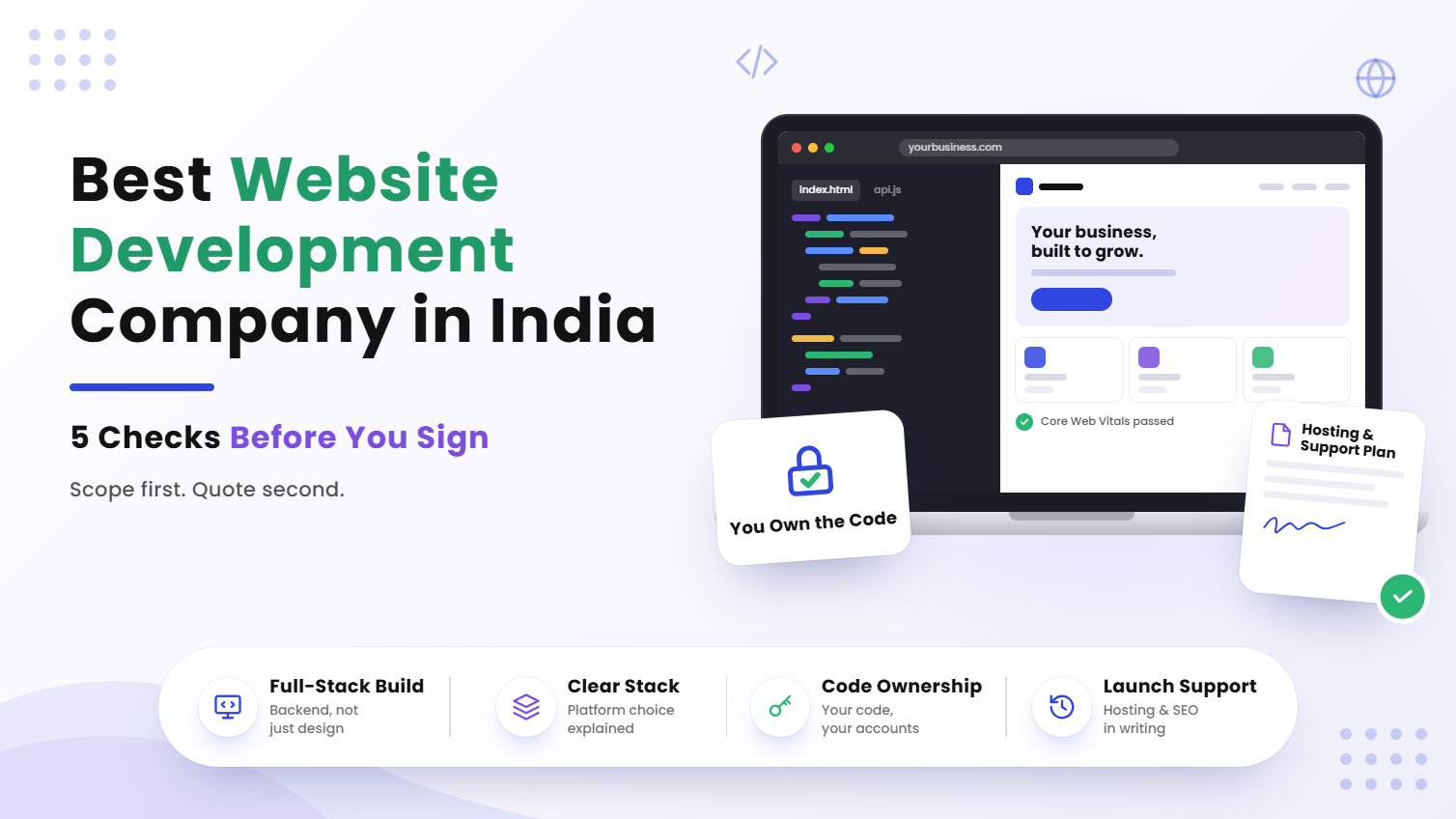
Quick answer: To choose a website development company in India, confirm five things before you sign:
- They build and maintain the backend, not just the design.
- They can explain why they recommend a particular platform.
- The contract spells out hosting, SEO foundations and post-launch support.
- You own the code and the accounts.
- Their portfolio includes sites from a similar industry or with similar complexity.
Ask for a quote only after a proper scoping conversation.
You might be right at the start, without knowing yet whether you need Shopify, Magento, WordPress or something custom. That’s fine, because most buyers don’t. This guide is written for that stage. It covers:
- what separates a design shop from a development partner
- the questions to ask on the first call
- how pricing models work
- how to read a portfolio properly
- why so many businesses outsource this work to India
Web Design Company vs Web Development Company: What’s the Difference?
People often treat the two terms as interchangeable. They aren’t, and mixing them up is a common reason website projects go wrong.
A web design company focuses on how the site looks and feels: layouts, colours, typography, page mockups and user flows. Some designers also build the pages, often with a template or page builder.
A web development company builds how the site works. That includes:
- the frontend code
- the backend (databases, admin panels, checkout logic, user accounts)
- integrations with tools such as your ERP, CRM or payment gateway
- performance and security patches
- ongoing updates after launch
Plenty of agencies do both. What matters is knowing which kind you’re actually talking to.
Comparison Table: Web Design vs Web Development
| What you need | Web design company | Web development company |
|---|---|---|
| Brand look, layouts, mockups | Core strength | Usually handled in-house or with a design partner |
| Frontend build (HTML, CSS, JavaScript) | Sometimes, often on templates | Yes |
| Backend logic (checkout, accounts, pricing rules) | Rarely | Core strength |
| Integrations (ERP, CRM, payments, shipping) | Rarely | Yes |
| Platform choice and architecture | Limited input | Should lead this conversation |
| Speed and Core Web Vitals work | Partial | Yes |
| Security patches, upgrades, bug fixes | Rarely | Yes, usually under a support plan |
| Best fit | Brochure sites, rebrands | Ecommerce, web apps, anything with moving parts |
Which One Do You Actually Need?
If your site is five pages that rarely change, a design-led studio may be enough. You need development capability if you plan to do any of these, now or as the site grows:
- sell online
- take bookings
- show customer-specific prices
- connect to inventory
A good test is to ask who will fix the checkout if it breaks after a plugin update. If the answer is vague, you’re probably talking to a design shop.
Questions to Ask a Website Development Company in India Before You Hire
Use this checklist on your first two calls. A good team will answer most of these questions before you ask. A weak one will keep steering the conversation back to price and timelines.
1. Tech Stack: Why This Platform for My Business?
You don’t need to know the right platform yet. You do need the agency to explain its recommendation in terms of your business:
- how big your catalog is
- how often content changes
- who on your team will edit it
- what it needs to connect to
- what it will cost to run in three years
Questions to ask:
- Why this platform and not the obvious alternative?
- What would make you recommend something different?
- Which parts use standard features, and which are custom code we’ll have to maintain?
- How easy is it to find other developers for this stack if we ever switch agencies?
Clutch’s 2026 web development pricing guide is useful here. It lists WordPress, PHP, Ruby on Rails, Drupal, Django and ReactJS all at $25 to $49 per hour, and notes that the hourly rate for website development does not change based on the technology being used. The stack still affects which integrations are possible and how easy the site is to manage later. So choose the platform for long-term fit, not for the hourly rate.
2. Hosting: Who Sets It Up, Who Pays, and Whose Name Is on It?
Hosting is where many first-time buyers get caught out. Ask:
- Is hosting included, or billed separately?
- Is the hosting account in my company’s name or the agency’s?
- Who handles backups, SSL certificates and server updates?
- What happens to the site if we stop working together?
Ideally the hosting, the domain and any paid platform accounts are all in your name, and the agency is given access. That way you can never be locked out of your own business.
3. SEO Foundations: What Is Built In From Day One?
SEO is much cheaper to build in than to add later. Google Search Central’s guidance on hiring an SEO says the best time to bring one in is when you’re planning a redesign or a new site, so it can be search-friendly from the bottom up.
A development partner doesn’t have to run your content marketing, but the build should include:
- Clean, readable URLs and a logical page structure
- Editable title tags and meta descriptions on every page
- An XML sitemap and a sensible robots.txt
- Correct canonical tags (a common ecommerce problem)
- Mobile-friendly, fast-loading templates
- 301 redirects from old URLs if you’re replacing an existing site
Speed is part of this. Google’s web.dev defines “good” Core Web Vitals as:
- Largest Contentful Paint (LCP) within 2.5 seconds
- Interaction to Next Paint (INP) of 200 milliseconds or less
- Cumulative Layout Shift (CLS) of 0.1 or less
These numbers aren’t vanity metrics. In a web.dev case study, Vodafone Italy ran an A/B test in which a 31% improvement in LCP led to 8% more sales. Ask any agency which thresholds it builds to and how it measures them.
4. Code Ownership: Who Owns the Code When the Project Ends?
Buyers forget this question more often than any other, and it matters more than they expect.
Under Section 17 of India’s Copyright Act, 1957, the author of a work is generally its first owner. The rule that the employer owns the work covers employees working under a contract of service. It doesn’t cover an outside agency hired for a project. In plain terms, paying for a website doesn’t automatically give you copyright in the custom code. Your contract has to say so.
Ask for:
- A written clause that assigns ownership of the custom code and design files to you on final payment
- Clarity on what won’t be yours (licensed themes, paid extensions, the agency’s reusable tools) and what licence you get to use them
- Access to the code repository, not just a ZIP file at the end
- Admin access to every account: hosting, domain, platform, analytics and payment gateway
This isn’t legal advice. On a large project, have your lawyer review the IP clause.
5. Post-Launch Support: What Happens After Go-Live?
A website isn’t finished at launch. Platforms release security patches, plugins update, and you’ll want changes. Ask:
- Is there a warranty period for bugs after launch? How long is it?
- What does the support plan cover: security patches, platform upgrades, small changes, speed work?
- Is support billed monthly, by the hour or per request?
- What are the response times, in writing, and in which time zone?
Be wary of anyone promising round-the-clock support for everything at a small monthly fee. Written response times you can rely on are worth more than a big promise.
The Short Version of the Checklist
- Can they explain why this platform suits my business?
- Is hosting in my name, and who maintains it?
- Which SEO basics are included in the build?
- Do I own the custom code, in writing?
- What does post-launch support cost and cover?
- Will the people on the sales call be the people building the site?
Website Development Pricing Models Explained
Most quotes follow one of three models, or a mix of them. Knowing which model you’re looking at makes quotes much easier to compare.
Fixed Project Price
You pay one price for a defined scope. Because you know the number upfront, budgeting is easy. The catch is that anything outside the agreed scope becomes a change request with its own cost. Fixed pricing works best when your requirements are clear and stable.
Hourly (Time and Materials)
You pay for the hours actually worked, usually against an estimate. This is flexible, so it suits projects where requirements will change. The risk is that the budget drifts, so ask for weekly time reports and a cap or alert threshold.
Monthly Retainer or Dedicated Team
You pay a monthly amount for a reserved block of hours, or for a dedicated developer or team. This suits ongoing work such as a growing store, regular feature releases or support after launch.
Pricing Models Compared
| Model | How you pay | Best for | Watch out for |
|---|---|---|---|
| Fixed project | One agreed price for a defined scope | Clear, stable requirements | Change requests for anything outside scope |
| Hourly | Hours worked, against an estimate | Evolving or exploratory projects | Budget drift without regular time reports |
| Retainer / dedicated team | Fixed monthly amount | Ongoing development and support | Unused hours, unclear deliverables |
What Do Projects Actually Cost?
Costs vary so much with scope that any single number is misleading. For context, here is what Clutch’s Web Development Pricing Guide reports. The guide was updated on September 21, 2026 and written by Hannah Hicklen, Content Marketing Manager at Clutch. Its data comes from first-party reviews by verified web development clients.
- Most web development projects on Clutch cost less than $10,000.
- Most agencies charge between $25 and $49 per hour.
- The most common hourly rate for India-based providers is under $25.
- The average reviewed project costs $66,499.09, with a typical timeline of 9 months and an average monthly cost of $7,138.93. Large builds pull these averages up.
The takeaway is that a simple brochure site and a full ecommerce platform sit in completely different budget ranges. A quote given before anyone has asked about your catalog, integrations and content is a guess.
How to Judge a Website Development Portfolio
Anyone can make a screenshot look good. What you need to know is whether this team has solved problems like yours.
Look for Similar Industry or Similar Complexity
A beautiful portfolio of five-page restaurant sites tells you little about whether a team can handle 5,000 SKUs with wholesale pricing. Look for at least one or two projects that match your situation in one of these ways:
- Same industry (similar customers, similar buying journey)
- Same complexity (catalog size, integrations, B2B logic, multiple stores or languages)
- Same platform (if you already have a preference)
Visit the Live Sites, Not Just the Images
Open the live sites on your phone. Search for a product, use the filters and add something to the cart. Does it feel fast? Does the layout jump around while it loads? Five minutes of clicking will teach you more than any case study PDF.
Read Case Studies for the Problem, Not the Adjectives
A useful case study explains what was broken, what was decided and why. Words like “seamless” and “world-class” tell you nothing. Look for specifics: what was migrated, what was integrated, what was kept, and what changed for the client’s team.
Questions to Ask About Any Portfolio Piece
- What exactly did your team do on this project?
- Is the site still live, and do you still support it?
- Can I speak to this client?
- What would you do differently now?
Why India Is a Common Choice for Outsourced Website Development
India has one of the largest technology services industries in the world. Nasscom’s Strategic Review 2026 estimates the industry’s FY26 revenue at $315 billion, up 6.1%, with $246 billion of that from exports. The export figure matters because it shows that much of the industry’s work is for clients outside India. Remote collaboration, documentation and overlapping working hours are a normal part of how it operates.
Cost is part of the picture. Clutch’s Web Development Company Pricing Guide 2026 lists India at under $25 per hour, compared with $100 to $149 for the United States, Canada and Australia. But cost isn’t the whole story any more. Deloitte’s Global Outsourcing Survey 2024, which drew on more than 500 global business and technology leaders, says that “access to talent has emerged as the number-one driver influencing outsourcing decisions.” It adds that while cost reduction remains a key driver, executives “are prioritizing skilled talent and agility in their outsourcing decisions.”
What to Watch For When Outsourcing to India
India’s market is huge and uneven. One search can turn up solo freelancers, large firms and everything in between. The checklist above matters even more when you hire across borders. Pay particular attention to:
- Who actually does the work. Some agencies use senior people to win the deal, then hand the project to juniors or subcontractors.
- Working-hour overlap. Ask how many hours of your working day the team will be reachable.
- Communication habits. Shared project boards, regular demos and written updates are better than long silences followed by a big reveal.
How Ethnic Infotech Works With International Clients
Ethnic Infotech is a software and ecommerce development company based in Surat, Gujarat. It started as a working partnership in 2020 and became a Private Limited company in 2025. The team works remotely with brands in the USA, UK, Europe and Asia, and most of its clients are outside India.
A few practical commitments shape how the team works:
- Direct teams. You meet the developers building your project on day one, and they stay with it through launch. There’s no maze of account managers and no swapping in juniors partway through.
- Planned overlap hours with your team, so questions get answered during your working day.
- Clear pricing. After a short discovery call, the team sends either a fixed quote for a defined project or a monthly cost for a dedicated team.
- A visible process. Discovery call, scope and architecture, UI/UX design, development sprints, QA and launch, then support and growth.
- Performance targets that meet Google’s “good” Core Web Vitals thresholds.
- Post-launch support, covering maintenance, upgrades and speed work, either on a monthly plan or as needed.
Ecommerce is the team’s deepest specialism: Magento and Adobe Commerce, Shopify and Shopify Plus, and headless storefronts. It also builds web and mobile apps, AI tools, DevOps pipelines and games.
Proof: Real Projects From Ethnic Infotech
These five published case studies show the range of problems a development partner should be able to handle. The platform decisions are very different from one project to the next. That’s the point: the right stack depends on the business.
Tong Garden: Headless Storefront on a Kept Magento Backend
Tong Garden’s storefront was moved from Magento to GraphCommerce, in partnership with Thirteen Ideation. Rather than replace the backend, the team kept Magento running the catalog and orders and rebuilt only the storefront customers see. The case study says this improved speed, reduced storefront overhead and gave customers a cleaner path to purchase.
Why it matters to you: sometimes the right answer isn’t a full rebuild. A good partner will tell you when to keep what works.
Fusion5: Magento Modernization for Retail and Wholesale Pricing
Fusion5 is a USA-based technology and electronics brand. The Magento modernization focused on better product discovery, advanced filtering, and support for both retail and wholesale pricing across a growing catalog. None of this required a full replatform.
Why it matters to you: if you sell to both consumers and businesses, pricing logic is a development problem, not a design one.
Zolamod: Shopify Store for Modular Tabletop Gaming Furniture
Zolamod is a USA-based brand selling modular gaming tables and accessories for tabletop players. Its Shopify store was built around premium product storytelling, one-week delivery messaging and a more flexible buying journey for configurable furniture.
Why it matters to you: Shopify is quick to launch and easy to edit. That suited a brand that needed to move fast and keep refining how its products are presented.
GoodBac: Shopify Experience With a Custom Product Quiz
GoodBac is a UK-based personalized probiotic brand. On its Shopify store, a custom quiz helps customers find the right science-backed blend, alongside messaging about made-to-order delivery and sustainable packaging.
Why it matters to you: guided selling (a quiz instead of a long product grid) is custom functionality. It’s the kind of feature to raise early in scoping.
Blue Lagoon: Magento Store for a Specialist Reptile Retailer
Blue Lagoon is a reptile shop in the Netherlands. It has specialized in terrarium construction and reptiles for more than 20 years and has over 250m² of retail space. The Magento project covered:
- making a large, multi-category catalog easier to browse
- migrating product and customer data from Offbiz
- applying critical security patches
- making checkout clearer
Blue Lagoon’s CEO, Pieter, left a Google review describing how the team restored the shop’s website after it “was completely lost due to a failure of our previous web agency.”
Why it matters to you: that review is the strongest argument for the code ownership and hosting questions above. If your site, code and accounts are in your name, an agency failure is an inconvenience rather than a crisis.
You can browse all published projects on the Ethnic Infotech case studies page.
Red Flags to Watch For
- A firm quote before anyone has asked about your business
- No live sites in the portfolio, only images
- Hosting, domain or platform accounts registered in the agency’s name with no plan to hand them over
- No mention of SEO basics or redirects in the proposal
- Vague answers about who will actually write the code
- Unlimited revisions or round-the-clock support promised at a very low price
- No written support terms for after launch
Choosing the Right Website Development Company in India
The right website development company in India isn’t the one with the flashiest homepage or the lowest number in the first email. It’s the team that asks good questions about your business, explains its platform choice clearly and puts ownership, hosting and support in writing. It should also be able to show you live projects that look like your problem. Use the checklist, compare quotes that use the same pricing model, and click through real sites before you sign.
Tell Us What You’re Building
Tell us what you’re building and we’ll walk you through the right approach and a realistic budget, no sales pressure. You’ll talk directly with the developers who would work on your project, not with a sales team. Start a conversation through the Ethnic Infotech contact page.
Frequently Asked Questions
How much does it cost to hire a website development company in India?
Cost depends heavily on scope, from a simple brochure site to a full ecommerce platform. That’s why a proper quote should come after a scoping conversation, not before one. Page count, catalog size, custom features, integrations and ongoing support all change the number. As a rough guide, Clutch reports that most web development projects on its platform cost under $10,000 and that India-based providers most commonly charge under $25 per hour. Complex ecommerce builds can cost far more.
How long does it take to build a website?
Most standard business websites take a few weeks. Ecommerce platforms with custom features or integrations usually take longer, depending on catalog size and complexity. Across all the web development projects reviewed on Clutch, which include large builds, the typical timeline is 9 months. The things that most often stretch a timeline are migrating data from an old platform, third-party integrations and how ready your content is. Ask for a milestone plan rather than a single launch date.
Does a website development company also handle hosting and SEO?
Many do, but it varies by agency. Confirm upfront whether hosting setup, basic SEO foundations and post-launch support are included or billed separately. At a minimum, the build should include technical SEO basics such as clean URLs, editable meta tags, an XML sitemap and redirects from old pages. Ongoing SEO campaigns and content marketing are often a separate service.
Planning your next product, platform, or growth move?
Ethnic Infotech helps teams shape scalable software, sharper customer experiences, and content systems that support real business growth.