
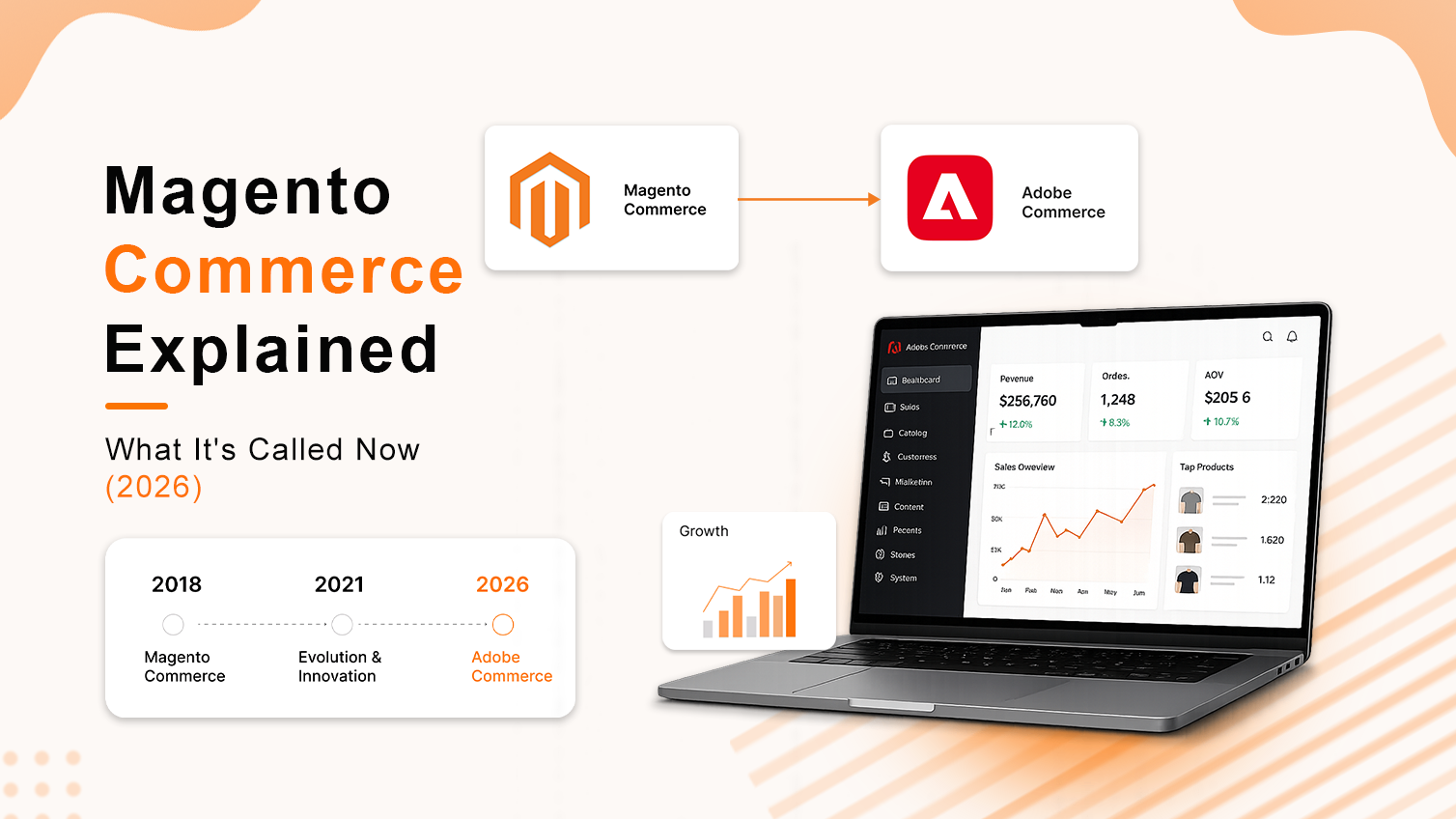
Here’s the direct answer:Magento Commerce was rebranded to Adobe Commerce after Adobe’s 2018 acquisition of Magento. If you’re being quoted “Magento Commerce” today, you’re either looking at outdated pricing or someone hasn’t updated their materials. The platform itself, the licensed, paid tier of Magento with B2B tools, managed cloud hosting, and Adobe’s support, is very much alive. It’s just wearing a different name.
That mix-up matters more than it sounds. We’ve had prospective clients budget for the wrong tier entirely because a proposal used old terminology. So let’s clear this up properly: what Magento Commerce became, what it costs now, and how to figure out whether your business actually needs it.
The Confusion Nobody Warned You About
If you’ve been shopping for an ecommerce platform and someone mentioned “Magento Commerce,” you’re not behind on the news. You’re just running into a naming problem that Adobe never fully cleaned up.
Search results for magento commerce still pull articles from 2016, agency case studies with the old branding, and Upwork job posts written by people who haven’t touched the platform in years. Google hasn’t sorted it out. Neither have half the agencies still bidding on projects.
So when a client tells us they need “Magento Commerce for our B2B store,” the first thing we do is figure out which product they actually mean. Sometimes it’s Adobe Commerce. Sometimes it’s Magento Open Source with a few extensions bolted on. Sometimes they’re not sure, and honestly, that’s fair. Nobody tells you the name changed.
What Magento Commerce Actually Became
Magento was built by Varien, launched in 2008, and grew into one of the biggest open-source ecommerce platforms around. In 2018, Adobe bought it. Within a couple of years, “Magento Commerce,” the paid enterprise edition, got folded into Adobe’s naming scheme and became Adobe Commerce.
The free, self-hosted edition kept the Magento name and is now called Magento Open Source. So there are effectively two products wearing one shared codebase:
Magento Open Source is free to download. You handle your own hosting, security patches, and server management. It has the same catalog engine, checkout flow, and admin panel as the paid edition, just without the commercial add-ons.
Adobe Commerce is the licensed edition, and this is what most people mean when they say “Magento Commerce” today. It adds native B2B functionality, Page Builder, customer segmentation, advanced reporting, AI-driven merchandising through Adobe Sensei, and access to Adobe’s official support.
There’s also Adobe Commerce Cloud, which is Adobe Commerce bundled with managed hosting on their own infrastructure, including a Fastly CDN and automated deployment tooling.
And for headless commerce Magento setups, both editions can run behind a decoupled frontend. We’ve done this with GraphCommerce for a client whose storefront needed to move faster than the traditional Magento theme layer allowed. More on that below.
One name you’ll hear more of: Mage-OS
Mage-OS is a community-maintained fork of Magento Open Source. It’s not affiliated with Adobe, and it exists specifically so the open-source side of Magento isn’t entirely dependent on Adobe’s roadmap priorities. If you’re on Open Source and worried about long-term support, this is worth knowing about. It’s not a third pricing tier of “Magento Commerce.” It’s a parallel, free alternative.
Magento Open Source vs Adobe Commerce: The Real Difference
Here’s where it gets interesting, because the decision rarely comes down to features alone.
The two editions share the same core codebase, admin panel, extension ecosystem, and upgrade schedule, so a developer experienced on one can generally work on the other without retraining. What separates them is a commercial layer Adobe has spent years building: B2B account hierarchies, negotiated pricing, staging environments, and AI merchandising tools.
That layer isn’t cheap. Adobe Commerce licensing starts at roughly $22,000 a year, and it scales upward from there based on your gross merchandise volume. For a store doing low seven figures a year, that number can feel steep next to a free Open Source install plus a good development team.
But scale changes the math fast. Adobe Commerce holds a real position at the top end of the market, running roughly 9% of the top one million ecommerce sites globally, with the installed base processing an estimated $173 billion in annual gross merchandise volume. That’s not a niche product. It’s the platform a meaningful chunk of large, complex retailers have chosen deliberately.
So the honest answer isn’t “which is better.” It’s “which one matches what your operations team actually needs.” A single-brand store with a straightforward catalog rarely needs Adobe’s B2B suite. A distributor managing tiered pricing for forty account types absolutely does.
What This Looks Like in Practice
Real experience section, not theory. We’ve shipped both editions, and the pattern repeats more than you’d expect.
Take our work with Blue Lagoon, a Netherlands-based reptile retailer with a genuinely large, specialist catalog. Filtering and browsing needed to stay fast even as the product range grew, and checkout had to stay simple despite the catalog’s complexity. Magento’s structure gave us the room to build that without fighting the platform.
Compare that to Fusion5, a technology and electronics brand that needed advanced filtering plus retail and wholesale pricing running side by side. That’s a B2B logic problem more than a storefront design problem, and it’s exactly the kind of workload Adobe Commerce’s account-based features were built for.
And then there’s Tong Garden, where the answer wasn’t “stay on Magento” at all. Their storefront was replatformed from Magento to a GraphCommerce headless setup, in partnership with Thirteen Ideation, specifically to cut storefront overhead and speed up page loads. Sometimes the right call is keeping the Magento backend and rebuilding the frontend. Sometimes it’s moving off entirely.
I’ll be honest about something most agencies won’t say out loud: we’ve talked clients out of Adobe Commerce more than once. If your catalog is under a few thousand SKUs, you’re B2C only, and you don’t need staging environments or customer segmentation, that license fee buys you very little you couldn’t get from Open Source and a solid development partner. We’d rather tell you that upfront than bill you for a tier you don’t need.
Choosing the Right Path for Your Store
Concrete steps, not vague encouragement.
- Map your actual B2B requirements first. If you have tiered account pricing, negotiated quotes, or company-level purchasing, that’s the strongest signal toward Adobe Commerce.
- Check your GMV against the license bands. Adobe Commerce pricing scales with gross merchandise volume. A store under $5 million GMV should scrutinize this number hard before committing.
- Decide who owns hosting and security. Open Source means you (or your dev partner) manage patching and infrastructure. Adobe Commerce Cloud takes that off your plate, at a cost.
- Test the extension ecosystem for your niche. Not every extension built for Open Source is available, or priced the same, on Commerce. Check before you assume feature parity.
- Plan the Magento 2 upgrade path regardless of edition. Magento 1 reached end of life in June 2020. If you’re still on it, this isn’t a “someday” project anymore.
For list-style comparison, here’s roughly how the two editions and the most common alternative stack up for a mid-size brand:
| Platform | Best For | Free or Paid | Setup Complexity | B2B Depth |
|---|---|---|---|---|
| Magento Open Source | Custom builds, dev-heavy teams | Free (self-hosted) | High | Add-on only |
| Adobe Commerce | Complex B2B, high GMV, enterprise | Paid (from ~$22k/yr) | High | Native |
| Shopify Plus | Fast-growing D2C, simpler catalogs | Paid (flat + fees) | Low-Medium | Limited |
That’s the shape of the magento vs shopify question too, and it comes up constantly. Shopify Plus is faster to launch and easier to manage day to day. Magento, in either edition, wins when your catalog structure, pricing logic, or B2B workflows are too complex for a templated platform to handle gracefully.
Common Mistakes Businesses Make Here
Budgeting off an old quote. Old “Magento Commerce” pricing floating around from 2019 doesn’t reflect current Adobe Commerce license tiers. Get a current quote before you plan a budget.
Assuming Open Source can’t scale. It can, and does, for plenty of large stores. The gap isn’t scale, it’s the commercial B2B and merchandising layer.
Skipping the Magento 2 upgrade because it “still works.” A Magento 1 site running today has had no security patches since 2020. That’s not a maintenance risk anymore, it’s an active liability.
Choosing Adobe Commerce for the brand name, not the features. We’ve seen businesses pay the license fee and never touch the B2B tools, staging, or segmentation they’re paying for. If you’re not using it, you’re paying for shelf space.
Ignoring the headless option entirely. Plenty of teams assume “Magento” means a traditional themed storefront. It doesn’t have to. Headless commerce Magento setups, like the GraphCommerce build we did for Tong Garden, exist precisely because the backend and the frontend don’t have to move at the same speed.
Frequently Asked Questions
What is Magento Commerce called now?
It’s called Adobe Commerce. The rename happened after Adobe acquired Magento in 2018, and it applies to the paid, licensed tier specifically, not the free Magento Open Source edition.
Is Magento Commerce the same as Adobe Commerce?
Functionally, yes. Adobe Commerce is the direct successor to what used to be called Magento Commerce (and before that, Magento Enterprise Edition). Same commercial feature set, new branding.
How much does Magento Commerce cost in 2026?
Under its current name, Adobe Commerce licensing starts around $22,000 a year for on-premise deployments and scales up based on gross merchandise volume. Adobe Commerce Cloud, with managed hosting included, runs higher.
Is Magento 1 still supported?
No. Magento 1 reached end of life in June 2020. It gets no official security patches, so running it today means running unpatched software on a live storefront.
Magento vs Shopify, which is better for a growing B2B brand?
Depends on your complexity, honestly. Shopify Plus is quicker to launch and lower-maintenance for straightforward D2C catalogs. Magento (either edition) tends to win once you need custom pricing logic, complex catalogs, or deep B2B account structures.
Do I need Adobe Commerce or is Magento Open Source enough?
If your team can handle hosting and security, and you don’t need native B2B account tools, customer segmentation, or staging environments, Open Source covers most stores just fine. Adobe Commerce earns its price tag once those needs show up.
How long does a Magento 2 upgrade take?
It varies with catalog size and custom code, but a typical mid-size store upgrade runs somewhere between six and twelve weeks, including testing. Heavily customized stores can take longer.
Is Magento Commerce worth it for a mid-size retailer in 2026?
For most stores under a few million in GMV without complex B2B requirements, probably not, Open Source or Shopify Plus usually makes more financial sense. Once B2B logic, catalog depth, or integration complexity increase, the calculation flips.
Where to Go From Here
So, still got an old “Magento Commerce” quote sitting in your inbox? Toss it. The name’s changed, the pricing’s changed, and the platform itself has moved on more than most people realize.
Here’s what actually matters: not what it’s called, but whether your catalog complexity and B2B workload justify Adobe Commerce’s license fee in the first place. For some stores, the answer is a clear yes. For a lot of others, Magento Open Source with a solid dev team gets the job done for a fraction of the cost.
We’ve helped brands work through exactly this decision, from catalog-heavy B2C retailers to full wholesale operations, and no two answers have looked the same. If you’re weighing Adobe Commerce against Open Source, or wondering whether a Magento to headless migration makes more sense for your storefront, our Magento development team can run the real numbers with you, not a sales pitch.
Still comparing platforms altogether? Our ecommerce replatforming guide covers that decision in more depth, and you’ll find more breakdowns like this one in our resources hub. When you’re ready, talk to the team.
Where to Go From Here
If you’re weighing Adobe Commerce against Open Source, or wondering whether a Magento to headless migration makes more sense for your storefront, our Magento development team can run the real numbers with you, not a sales pitch.
Planning your next product, platform, or growth move?
Ethnic Infotech helps teams shape scalable software, sharper customer experiences, and content systems that support real business growth.