
Quick Answer:Headless commerce development separates your store’s frontend (what shoppers see) from the backend (inventory, orders, pricing) and connects them through APIs. The result is a faster, more flexible storefront that isn’t locked into your platform’s default theme engine. It’s not automatically the right move for every brand but for catalogs with complex merchandising or teams chasing better Core Web Vitals scores, it usually pays off within a year.
And here’s the thing “headless” gets thrown around as a buzzword by agencies that haven’t shipped one. We have. This guide covers what it actually is, how it works, what it costs in India, and when it’s genuinely worth the switch in 2026.
What Is Headless Commerce Development? A Simple Explanation
Traditional ecommerce platforms bundle everything together. Shopify’s theme engine, Magento’s Luma frontend, WooCommerce’s PHP templates the storefront and the backend ship as one package. Change the frontend, and you’re often fighting the platform’s own rendering rules.
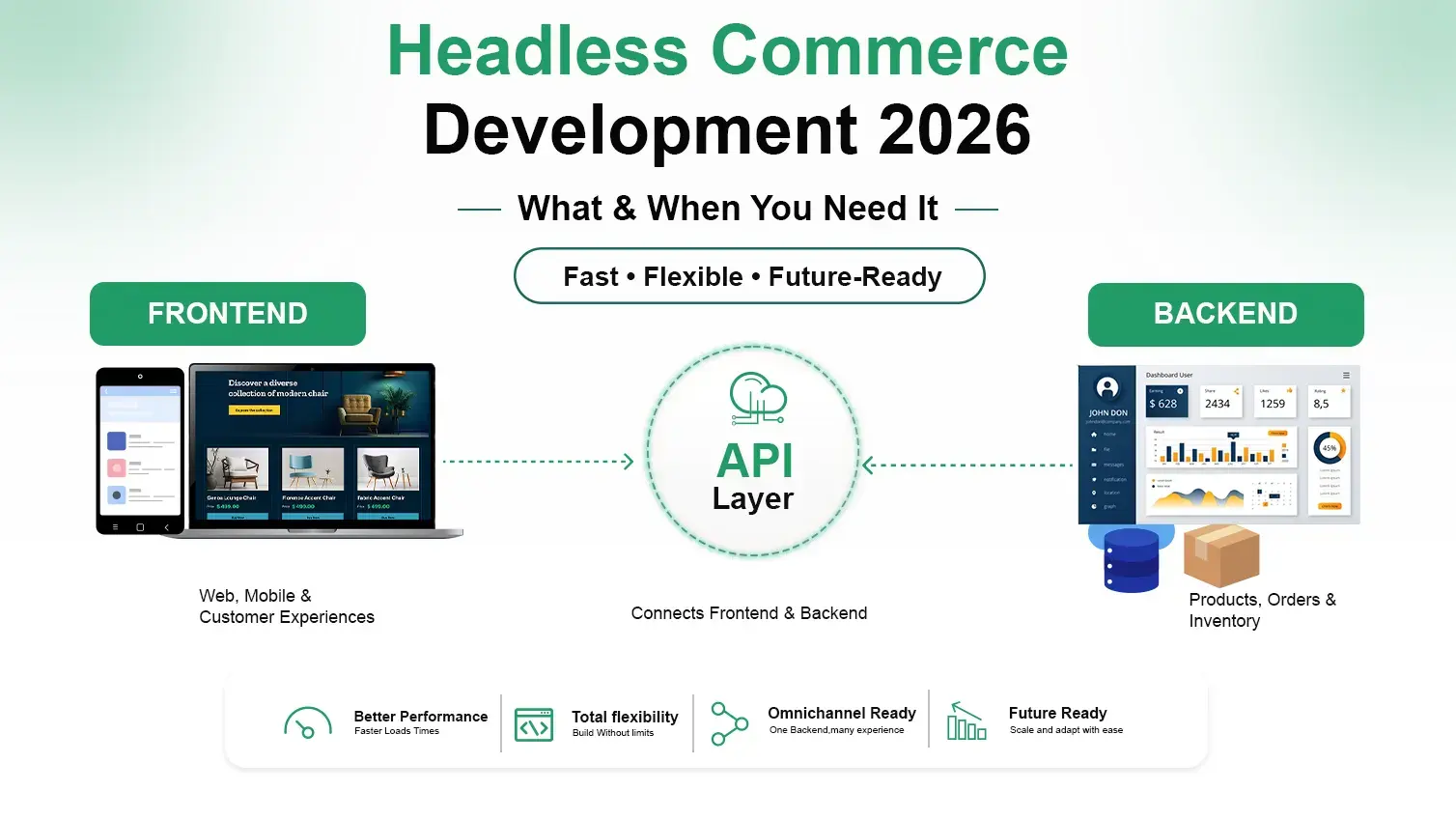
Headless commerce development strips that coupling apart. The backend keeps handling inventory, checkout logic, orders, and pricing. The frontend becomes a separate application usually built in React or Next.js that pulls data from the backend through an API, most often GraphQL.
Think of it like a restaurant kitchen and dining room run by two different teams that only talk through order tickets. The kitchen doesn’t care what the dining room looks like. The dining room doesn’t touch the stove. Each side moves faster because neither is waiting on the other’s redesign schedule.
This isn’t a new idea headless CMS platforms have worked this way for a decade. What’s changed by 2026 is that headless commerce development has matured enough for mid-market brands, not just enterprise catalogs with dedicated engineering teams.
How Headless Commerce Works: Frontend vs Backend
Here’s where it gets concrete. In a headless commerce architecture, you have three moving parts:
- The backend (commerce engine). This stays as Adobe Commerce, Shopify, or a similar platform it still manages products, orders, customers, and payments.
- The API layer. GraphQL (used by GraphCommerce and Shopify’s Storefront API) exposes just the data the frontend needs, nothing more.
- The frontend (storefront). A React-based application Shopify Hydrogen or a custom Next.js build renders pages, handles routing, and controls every pixel of the shopping experience.
So what does that mean practically? You can redesign your entire storefront without touching a single line of backend code. You can also run multiple frontends off one backend a web store, a kiosk app, and a mobile app all pulling from the same product data.
Does this mean more moving parts to maintain? Yes. That’s the trade-off nobody mentions enough. You gain speed and flexibility. You take on frontend hosting, API monitoring, and a build pipeline that a bundled platform used to handle for you.
Headless Commerce vs Traditional Commerce: Key Differences
We get asked to compare these constantly, so here’s the table we actually walk clients through.
| Factor | Traditional Commerce | Headless Commerce |
|---|---|---|
| Frontend control | Limited to theme/template system | Full custom control (React/Next.js) |
| Page speed | Depends on theme bloat, plugins | Typically faster smaller payloads |
| Development cost | Lower upfront | Higher upfront, lower long-term drag |
| Omnichannel (app + web + kiosk) | Difficult, often duplicated builds | One backend, multiple frontends |
| Team skillset needed | Platform-specific (Liquid, PHP) | React/GraphQL engineering |
| Time to first launch | Faster | Slower usually 8-14 weeks longer |
Traditional commerce still wins for brands that need to launch fast and don’t have engineering resources on standby. Headless commerce development wins once your catalog complexity, traffic, or conversion rate depends heavily on frontend performance and flexibility.
Top Headless Platforms in 2026: Shopify Hydrogen, GraphCommerce
Two platforms dominate the conversations we’re having with clients right now.
Shopify Hydrogen is Shopify’s own React framework, built on Remix, for headless storefronts backed by Shopify or Shopify Plus. According to Shopify’s Hydrogen documentation, the framework is built specifically to work with Shopify’s Storefront API and ships with performance optimizations out of the box. It’s the natural path if you’re already on Shopify and want a custom frontend without leaving the ecosystem checkout, payments, and app integrations stay native.
GraphCommerce does the same job for Adobe Commerce and Magento catalogs. It’s a React/Next.js framework that talks to Magento’s GraphQL API, and it’s what we used to rebuild Tong Garden’s storefront a Magento-to-GraphCommerce replatform that improved speed and cut storefront overhead. You can see the Tong Garden case study for the specifics.
Beyond those two: Commercetools and Medusa show up in enterprise conversations, but for most mid-market brands in 2026, Hydrogen and GraphCommerce cover 90% of real-world use cases. I won’t get into custom Vue-based headless setups here that’s a smaller niche and deserves its own post.
Performance Benefits: Core Web Vitals with Headless
This is usually the actual reason someone calls us about headless commerce development. Not the architecture diagram the page speed report.
Google’s Core Web Vitals measure Largest Contentful Paint, Interaction to Next Paint, and Cumulative Layout Shift and according to Google Search Central’s page experience guidance, these metrics directly influence how your pages perform in search, particularly on mobile.
Headless storefronts generally score better because:
- The frontend ships only the code it needs, not a full theme’s worth of unused CSS and JavaScript.
- Server-side rendering (SSR) with frameworks like Hydrogen or Next.js delivers a fully-formed page on first load instead of waiting on client-side JavaScript to build it.
- Image and asset optimization is handled at the framework level, not bolted on through a third-party app.
We’re not going to pretend headless is a magic fix a badly built headless storefront can be just as slow as a bloated theme. The gains come from the engineering discipline headless architecture forces on a team, not the label itself.
Is Headless Commerce Right for Your Brand?
Short answer: probably not if you’re doing under $500K a year in revenue with a simple catalog. Probably yes if any of these sound like you:
- Your current theme can’t support the merchandising or content experience your marketing team wants.
- You’re running multiple storefronts (web, app, kiosk) off the same product catalog and duplicating work.
- Core Web Vitals scores are actively hurting your paid search Quality Score or organic rankings.
- Your catalog has B2B pricing tiers, complex configurators, or logic your current theme fights against.
Say you’re running a Shopify store doing around ₹40 lakh a month with a catalog under 500 SKUs headless is probably overkill right now. Say you’re an Adobe Commerce brand managing 5,000+ SKUs across three regions with a marketing team that wants weekly content updates that’s exactly where GraphCommerce or a custom headless build earns its cost.
Ready to Build a Faster Headless Store?
Deliver lightning-fast shopping experiences with a modern Headless Commerce architecture. Our experts help you improve performance, scalability, and customer experience while future-proofing your eCommerce business.
How Ethnic Infotech Delivers Headless Commerce Builds
We’re not a 40-service agency that added “headless” to a list. Headless commerce development is one of four things we do alongside Shopify Plus development, Adobe Commerce development, and general ecommerce development and it’s the one that gets the most misunderstanding from clients before kickoff.
When we scoped the Tong Garden replatform in partnership with Thirteen Ideation, the brief looked simple on paper move from Magento to a GraphCommerce frontend. Three weeks in, the real work turned out to be the GraphQL query structure, not the React components. We’d underestimated how much backend cleanup a headless migration forces you to do first. The storefront came out faster and lighter, but the honest lesson was: budget more time for backend API planning than the frontend build itself.
Our headless commerce development process runs through discovery, API architecture, frontend build (Hydrogen or GraphCommerce depending on your existing platform), and staged testing before launch the same delivery process we run on every ecommerce build, just with an extra API-planning stage up front. We work from Surat, India, with clients across the UK, Singapore, and Australia, so timezone handoffs are planned in from day one, not figured out mid-project.
If your team is weighing this decision, explore our headless commerce solutions or book a scoping call we’ll tell you honestly if headless is the right call for your catalog, not just sell you the bigger project.
Frequently Asked Questions
Q: What is headless commerce in simple terms?
A: Headless commerce separates your store’s frontend (what customers see) from the backend (inventory, orders, payments), connecting them through an API. This lets you build a custom, fast storefront without being locked into your platform’s default theme system. It’s most useful for brands needing design flexibility or multi-channel selling.
Q: Is headless commerce faster than traditional Shopify?
A: Generally yes, because headless frontends ship less unused code and can use server-side rendering for faster first paint. A standard Shopify theme can still be fast if well-optimized, but headless architecture makes strong Core Web Vitals scores easier to hit consistently, especially on image-heavy catalogs.
Q: What are the best headless commerce platforms in 2026?
A: Shopify Hydrogen leads for brands staying on Shopify or Shopify Plus. GraphCommerce is the strongest option for Adobe Commerce and Magento catalogs. Commercetools and Medusa serve larger enterprise use cases. Platform choice depends mainly on which backend you’re already running.
Q: How much does headless commerce development cost in India?
A: Headless commerce development through an India-based team typically runs higher than a standard theme build, since you’re paying for custom frontend engineering and API architecture. Exact cost depends on catalog size, integrations, and platform. Ethnic Infotech scopes each project individually after a discovery call reach out for a project estimate.
Explore Headless Commerce Solutions
If your team is weighing this decision, explore our headless commerce solutions or book a scoping call we’ll tell you honestly if headless is the right call for your catalog, not just sell you the bigger project.
Planning your next product, platform, or growth move?
Ethnic Infotech helps teams shape scalable software, sharper customer experiences, and content systems that support real business growth.