
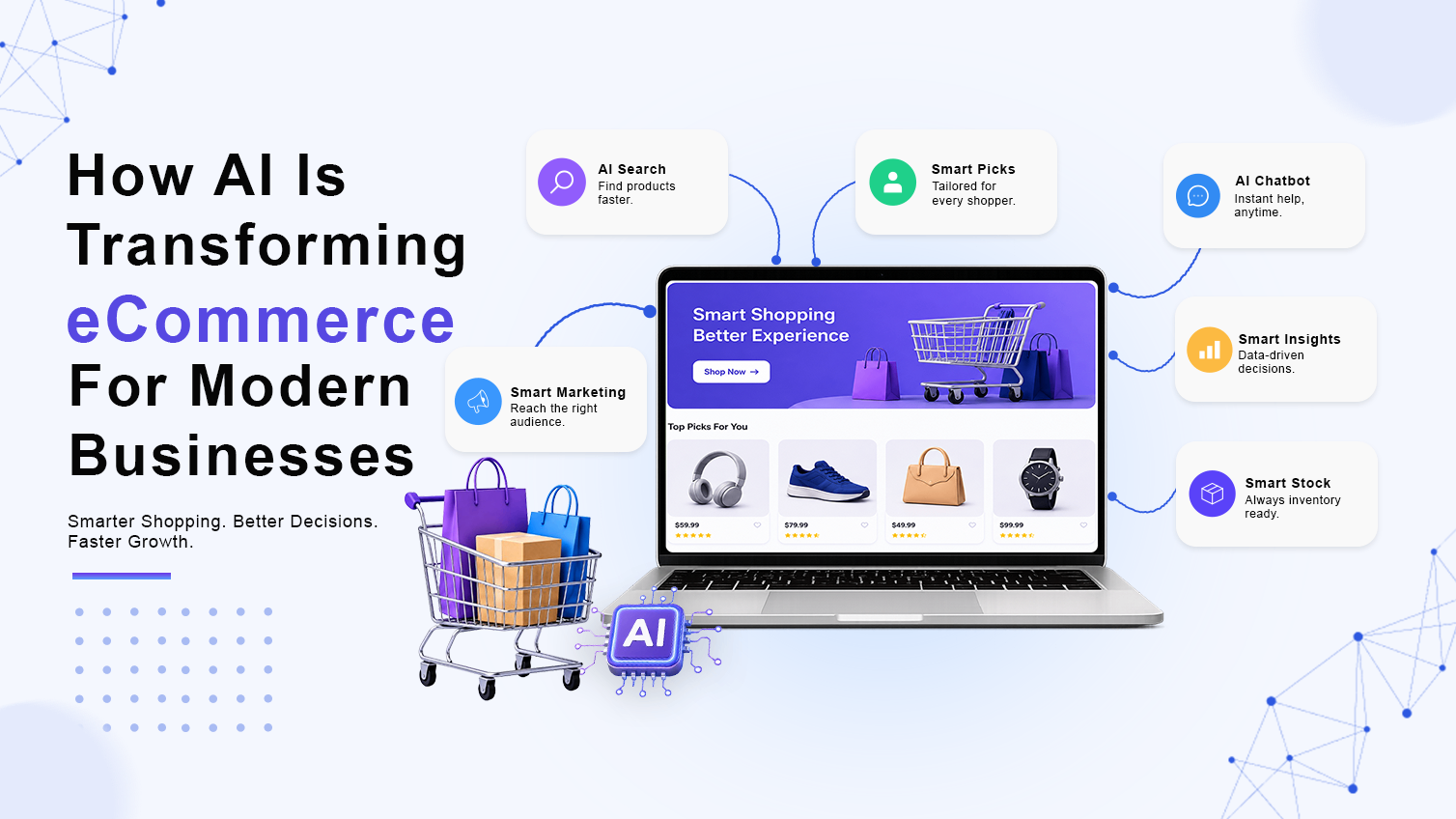
That’s the problem AI in eCommerce actually solves. Not in some distant, futuristic way. Right now. At Ethnic Infotech, we work with businesses building and scaling digital commerce platforms and the shift toward AI-powered functionality isn’t a trend we’re watching from a distance. It’s the thing clients ask us about most.
What Is AI in eCommerce?
AI in eCommerce is the application of machine learning, natural language processing, and data analytics to help online businesses make smarter, faster decisions at scale.
Instead of showing every customer the same homepage, the same product order, and the same promotions, AI analyses browsing history, purchase patterns, time of day, and dozens of other signals to deliver experiences that feel personal.
It doesn’t replace human strategy. But it processes and acts on data at a speed and scale no team could manage manually.
Why AI Matters for Modern eCommerce Businesses
Here’s the honest picture: customers expect more than they used to, and they’re less patient than ever.
According to Salesforce’s State of the Connected Customer report (2024), 73% of customers expect companies to understand their unique needs and expectations. And 62% say they expect businesses to anticipate those needs before they even ask. That’s not a small bar to clear especially when you’re running a mid-sized Shopify or Magento store without an enterprise budget.
AI helps bridge that gap. It lets a business with 50,000 SKUs behave as if it knows each shopper individually without hiring 50 extra people to make that happen.
The operational argument is just as strong. Managing inventory, pricing, customer queries, and marketing campaigns simultaneously gets messy fast. AI doesn’t eliminate complexity, but it brings order to it. Decisions that used to take days of analysis can happen in real time.
Key Ways AI Is Transforming eCommerce
1. Personalised Shopping Experiences
Personalisation is probably the word you’ve heard most in eCommerce circles this decade. But there’s a difference between basic personalisation “hello, [first name]” in an email and the kind of deep, behavioural personalisation AI makes possible.
AI analyses what a visitor browsed, what they skipped, how long they paused on a product, what they bought before, and what similar customers ended up purchasing. It then shapes the experience around that data in real time.
This shows up in several practical ways:
- Homepage product ordering changes based on individual preference
- Search results rank differently depending on your browsing profile
- Email campaigns surface products timed to your purchase cycle
- Promotions trigger based on behaviour, not calendar
When it works well, customers don’t notice the AI. They just feel like the store gets them. That feeling is worth a lot.
2. Smarter Product Recommendations
Recommendation engines are one of the most well-documented AI applications in eCommerce. McKinsey research has attributed up to 35% of Amazon’s revenue to its recommendation engine and while that’s Amazon-scale, the principle holds across the industry.
A well-configured recommendation system does more than “customers also bought.” It understands:
- Complementary products (a belt to go with the trousers)
- Style consistency (if you bought minimalist items before, surface more of that)
- Timing (don’t recommend a summer dress in January to someone in Scotland)
The result is higher average order value and fewer missed upsell opportunities both without adding friction for the customer.
3. AI Chatbots and Customer Support Automation
Customer support is where a lot of eCommerce businesses quietly struggle. Response times slip. Queries pile up over weekends. A customer who can’t track their order sends three emails before getting a reply.
AI chatbots don’t fix every support problem but they handle the volume that burns teams out. According to IBM (2023), businesses that implement AI-powered customer service report up to 30% reduction in support costs and measurable improvement in first-response time.
What can a well-built chatbot actually manage?
- Order tracking and delivery status queries
- Return and refund process guidance
- Product information and availability questions
- Basic troubleshooting for digital products
- After-hours queries without the wait
The key word is “well-built.” A chatbot that can’t understand natural language and forces users down a rigid decision tree will annoy more customers than it helps. The AI-powered conversational tools available now trained on actual support conversations are considerably better than the rule-based bots of five years ago.
If you’re exploring AI chatbot development for your store, the difference between a basic bot and a genuinely useful one comes down to how it’s trained and what data it has access to.
4. Better Search and Product Discovery
Search is one of the most underrated levers in eCommerce. If a customer types “dark blue slim fit jeans men 32” and gets zero relevant results, they don’t assume the store doesn’t have them. They assume the store is broken and they leave.
Traditional keyword matching breaks down fast. Customers type the way they think, not the way your product tags are structured.
AI-powered search understands intent rather than exact match. It handles:
- Spelling errors and typos without returning a “no results” page
- Synonym recognition (“sneakers” and “trainers” returning the same results)
- Voice search phrasing
- Visual search uploading a photo to find similar products
- Contextual ranking adjusting results based on season, location, or past behaviour
For large catalogues with thousands of products, this is the difference between a functional store and one that actually converts at scale.
5. Inventory and Demand Forecasting
Overstocking ties up cash. Stockouts lose sales. Both damage customer trust and both happen regularly when inventory decisions are based on gut feel or historical spreadsheets alone.
AI forecasting changes the inputs. Instead of looking only at last year’s sales data, it analyses:
- Seasonal trends with regional variation
- Marketing campaign schedules and expected traffic lifts
- Supplier lead times and reorder points
- External signals like competitor stockouts or trending products
The result isn’t a perfect crystal ball but it’s considerably more accurate than manual planning. Gartner’s 2024 Supply Chain Technology Report noted that companies using AI-driven demand forecasting reduced excess inventory by an average of 20-30% within the first 18 months of deployment.
That has a direct effect on cash flow, warehouse costs, and the ability to respond quickly when a product suddenly takes off.
6. Dynamic Pricing Strategies
Pricing in eCommerce is no longer a set-and-forget decision. Competitor prices shift daily. Demand fluctuates by hour. Margin pressure comes from all directions.
AI-powered dynamic pricing monitors competitor prices, customer demand patterns, stock levels, and historical conversion data to suggest or automatically apply price adjustments in real time.
This isn’t about a race to the bottom. Done properly, dynamic pricing:
- Protects margin during low-demand periods
- Adjusts upward when demand spikes without losing conversions
- Responds to competitor promotions intelligently
- Creates personalised pricing for loyalty tiers or segments
It requires careful configuration and human oversight on price floors and ceilings but the businesses using it effectively report measurably better margin performance compared to static pricing models.
7. Fraud Detection and Risk Reduction
As online transaction volumes have grown, so has the sophistication of fraud. Chargeback fraud, account takeover attempts, and card-not-present fraud have become significant operational risks for eCommerce businesses of all sizes.
AI fraud detection systems analyse hundreds of signals simultaneously device fingerprint, purchase pattern, location data, order velocity, payment history to flag suspicious activity before it processes.
The advantage over rule-based systems is adaptability. Fraud patterns evolve. A rule-based system gets beaten when fraudsters learn the rules. An AI model retrained on recent data keeps up. Stripe’s internal fraud research (2024) found that machine learning-based fraud detection reduces false declines by up to 40% compared to static rule sets meaning fewer legitimate customers get incorrectly blocked.
8. Marketing Automation and Better Targeting
Marketing spend without targeting precision is expensive guesswork. AI changes how segments are defined, how messages are timed, and how campaigns get optimised after launch.
AI-driven marketing can:
- Segment customers by predicted lifetime value, not just past purchases
- Identify customers at churn risk and trigger retention campaigns automatically
- Personalise ad creatives based on browsing and purchase behaviour
- Optimise email send time per individual recipient
- Analyse campaign performance in real time and reallocate budget accordingly
The shift from calendar-based to behaviour-based marketing tends to improve both engagement and efficiency more relevant messages reaching the right people at the right moment, rather than a broadcast to everyone on a list.
If you’re working with AI automation services, the marketing automation layer is often one of the fastest places to see measurable results.
Benefits of AI in eCommerce
Let me put this plainly. The businesses we see getting the most from AI aren’t the ones who treat it as a buzzword project. They’re the ones who tied each AI investment to a specific problem they were already trying to solve.
Improved Customer Experience
Faster, more relevant interactions across every touchpoint from search to support without requiring manual personalisation at scale.
Higher Conversion Rates
When product recommendations match what customers actually want, and search surfaces the right results, more visits turn into purchases.
Increased Operational Efficiency
Automating repetitive tasks support queries, inventory alerts, email sends frees teams to focus on decisions that genuinely need human judgement.
Better Business Decisions
AI provides data-driven insights that reduce reliance on instinct alone. Not because instinct is bad, but because it’s better when it’s backed by real signals.
Stronger Customer Retention
Relevant experiences and fast support keep customers coming back. Retention is almost always cheaper than acquisition AI makes retention more systematic.
Scalable Growth
An AI-powered store can handle 10x the traffic without 10x the staff. That’s the infrastructure argument, and it matters enormously once growth starts accelerating.
Ready to Transform Your Ecommerce Store with AI?
From AI-powered product recommendations and intelligent search to customer support chatbots and business automation, our ecommerce experts help you implement AI solutions that improve customer experiences, increase conversions, and accelerate business growth.
Challenges Businesses Should Consider
This isn’t a section most blog posts include honestly. But it should be.
Not every AI implementation works. Some common places things go wrong:
- Data quality issues. AI is only as good as the data it’s trained on. If your product data is inconsistent, your customer records are messy, or your historical sales data has gaps, the AI outputs will reflect that.
- Platform integration complexity. Bolting AI tools onto an existing Magento or Shopify setup isn’t always seamless. Middleware, API reliability, and data pipeline architecture all matter.
- Choosing the wrong use case first. Some businesses try to implement AI everywhere at once. The better approach is picking one or two high-impact, measurable areas and proving the model before expanding.
- Balancing automation with human oversight. Automated pricing, automated responses, automated promotions all of these need human guardrails. The goal is augmentation, not full removal of human judgement.
- Measuring ROI properly. “AI is improving things” is not a measurement. Define what you’re measuring before you start conversion rate, support resolution time, inventory accuracy, average order value. Otherwise you can’t tell if it’s working.
How to Start Using AI in eCommerce
You don’t need to transform everything overnight. And you shouldn’t.
A practical starting sequence for most mid-sized eCommerce businesses:
- Start with AI-powered product recommendations. Low integration complexity, measurable impact on average order value, relatively quick to deploy.
- Add intelligent on-site search. Particularly high value for stores with large catalogues.
- Implement chatbot support for common queries. Start with the 10 questions your support team gets most often.
- Layer in marketing personalisation. Email segmentation and timing optimisation before moving to ad-level personalisation.
- Build toward demand forecasting. This requires cleaner data infrastructure, so it often makes sense once the easier wins are in place.
Starting small allows you to test results, learn what works for your specific customer base, and build confidence in the technology before committing larger budgets.
For businesses working with an eCommerce development partner, this staged approach is usually what we recommend both to manage risk and to build internal capability alongside the technology.
What Actually Changes When AI Is Implemented Well
I’ve worked with enough eCommerce builds to say something plainly: the stores that use AI well don’t feel like they’re using AI.
They just feel fast. Relevant. Easy.
The stores that implement AI poorly or for the wrong reasons usually add friction rather than remove it. The chatbot that can’t actually answer your question. The recommendation engine that surfaces the thing you just bought. The dynamic pricing system that raises prices the moment you add something to your cart.
The technology isn’t the differentiator. The implementation is.
What I’ve seen work consistently: define the customer problem first, choose the AI tool second, measure the outcome third. Not the other way around.
The businesses we’ve helped at Ethnic Infotech that get this right tend to start with one friction point usually support volume or search irrelevance and build from there. Within 6 to 9 months of that approach, the difference in customer satisfaction metrics and team workload is significant enough that they expand the AI investment confidently, not tentatively.
That’s the version of AI transformation that actually delivers.
Real-World Context: How AI Adoption Looks Across Store Sizes
These aren’t guarantees results depend heavily on data quality and platform architecture. But they’re realistic reference points based on project patterns we see regularly.
| Business Type | Most Impactful First AI Use Case | Expected Timeframe to Results |
|---|---|---|
| Small store (< 5,000 SKUs) | AI-powered search & chatbot support | 4–8 weeks |
| Mid-size store (5k–50k SKUs) | Recommendation engine + demand forecasting | 2–4 months |
| Large catalogue (50k+ SKUs) | Personalisation + dynamic pricing | 3–6 months |
| High-traffic seasonal business | Demand forecasting + fraud detection | 2–3 months |
The Future of eCommerce Is AI-Driven
The direction is clear. Gartner predicts that by 2028, more than 70% of eCommerce platforms in the mid-market and enterprise segment will include some form of embedded AI for personalisation or automation up from under 35% in 2024.
But “AI-driven” doesn’t mean fully automated. The businesses that will compete most effectively aren’t removing humans from the equation. They’re using AI to make the humans more effective better information, faster decisions, more time for the work that genuinely requires creativity and relationship.
The competitive question in the next few years won’t be whether your store uses AI. Most will. The question will be whether your AI is configured intelligently, maintained properly, and genuinely improving the customer experience or just ticking a box.
FAQ
How is AI used in eCommerce?
AI in eCommerce is used to personalise product recommendations, power intelligent search, automate customer support via chatbots, optimise pricing dynamically, forecast inventory demand, detect payment fraud, and improve marketing targeting. Each application analyses customer and operational data to make faster, more accurate decisions than manual processes allow.
What are the key benefits of AI for online stores?
The primary benefits are improved customer experience through personalisation, higher conversion rates from relevant recommendations and better search, reduced operational costs through support automation, and better inventory management through demand forecasting. Businesses that implement AI strategically starting with defined problems typically see measurable improvements within 3 to 6 months.
How do AI chatbots help eCommerce businesses?
AI chatbots handle high-volume, repetitive customer queries order tracking, return policies, product information, delivery updates without requiring a human agent for each interaction. This reduces response time, lowers support costs, and allows human teams to focus on complex cases. Modern AI chatbots use natural language processing to understand varied phrasing rather than forcing users through rigid decision trees.
Can small or mid-sized eCommerce businesses afford AI?
Yes. Many AI tools are available as SaaS products or platform integrations at accessible price points. The key is choosing the right entry point typically AI-powered search or basic recommendation functionality and demonstrating ROI before expanding. You don’t need an enterprise budget to get meaningful results; you need clear goals and the right implementation approach.
Final Thoughts
AI is transforming eCommerce by making stores faster, more relevant, and more efficient but only when the implementation is thoughtful. The technology doesn’t create the advantage; applying it to a real problem with measurable outcomes does.
For businesses planning to build or upgrade an eCommerce platform, the right time to think about AI integration is at the architecture stage not as an afterthought once the store is live.
At Ethnic Infotech, we help growing businesses build eCommerce platforms that are ready for where the market is heading. If you’re exploring what AI could do for your store specifically, start a conversation with our team and we’ll work through it from a practical, delivery-focused angle.
Build an AI-Ready eCommerce Platform
At Ethnic Infotech, we help growing businesses build eCommerce platforms that are ready for where the market is heading. If you’re exploring what AI could do for your store specifically, start a conversation with our team and we’ll work through it from a practical, delivery-focused angle.
Planning your next product, platform, or growth move?
Ethnic Infotech helps teams shape scalable software, sharper customer experiences, and content systems that support real business growth.