
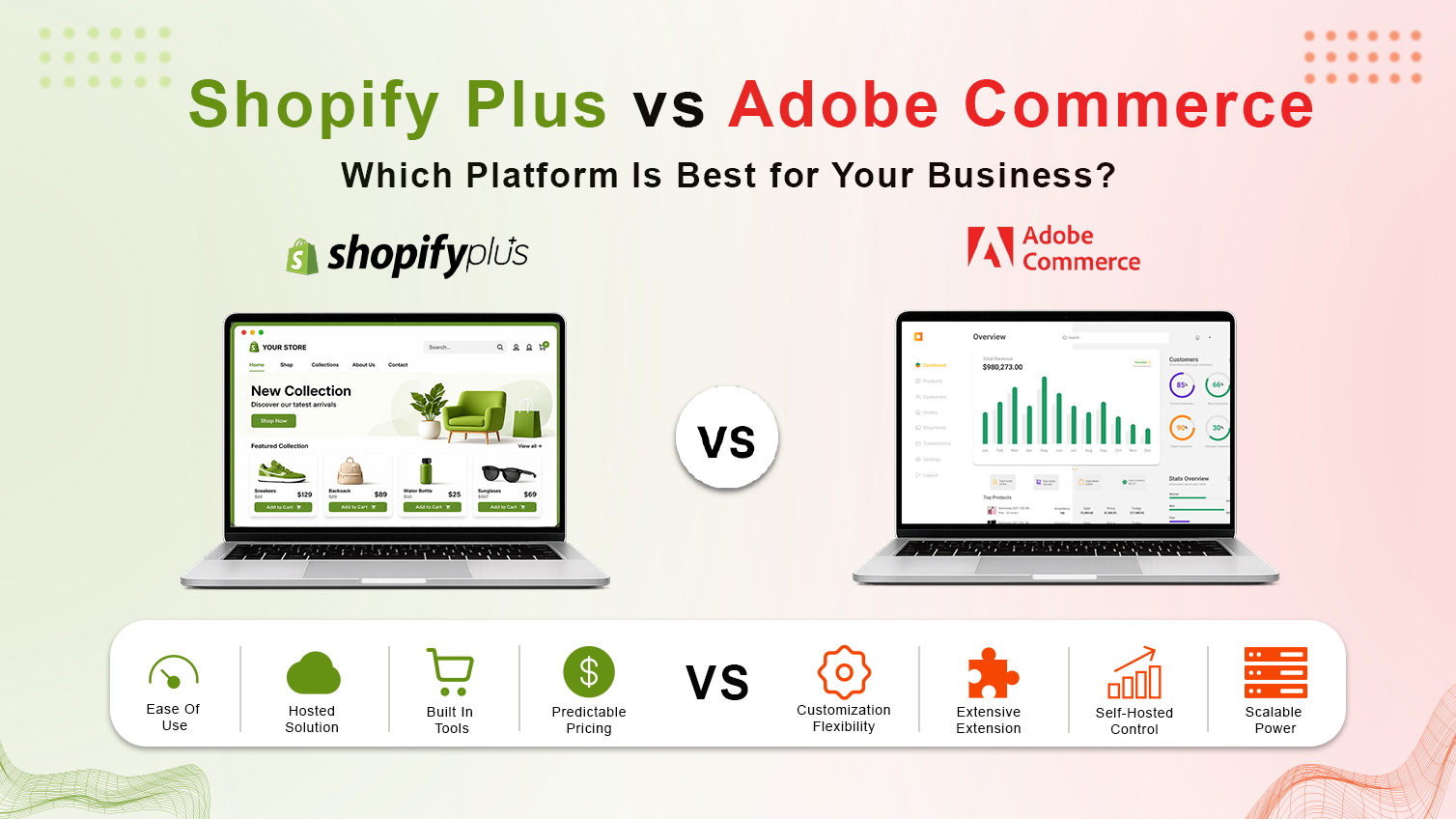
We’ve built on both platforms for international brands since 2021 – Shopify Plus storefronts for D2C brands in the UK and Singapore, Adobe Commerce builds for catalog-heavy B2B operations across India and Europe. So here’s the short version before we get into the weeds: Shopify Plus and Adobe Commerce solve different problems for different teams. Picking based on a sales deck instead of your actual catalog, team, and growth plan is how six-figure mistakes happen.
The Decision Most Teams Get Wrong
If you’re reading this, you’re probably holding two proposals from two different agencies, and they don’t even agree on what “enterprise” means. One says Shopify Plus will save you money. The other says Adobe Commerce gives you control you’ll need later. Both are right – depending on what your business actually looks like in eighteen months. That’s the part most comparison articles skip.
Maybe there’s also a board that wants a number, not a philosophy. Fair enough. Let’s get to the numbers.
What Shopify Plus Actually Is in 2026
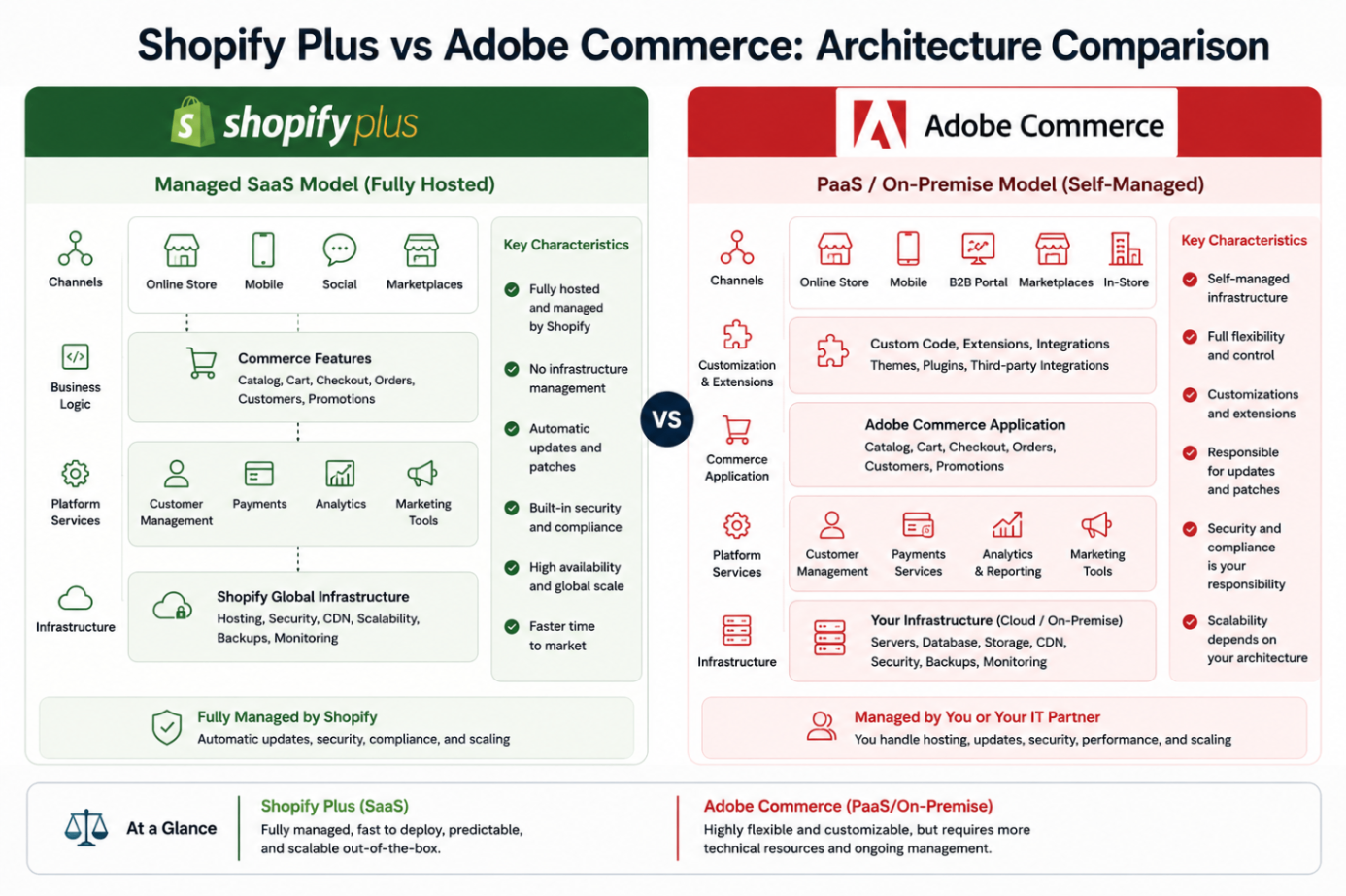
Shopify Plus is Shopify’s enterprise SaaS tier. It runs on the same multi-tenant cloud infrastructure as standard Shopify, with higher API limits, checkout customization, Shopify Functions, and dedicated support stacked on top. It’s used when a brand needs enterprise reliability without running its own servers.
Pricing starts at $2,300/month on a three-year term or $2,500/month on a one-year term, and that covers GMV up to roughly $800,000-$1,000,000 a month. Cross that threshold and Shopify shifts to a variable fee – around 0.25% of GMV – capped near $40,000/month for the highest-volume merchants. That structure means small and mid-size brands get a flat, predictable bill. Big ones pay more, but proportionally.
Here’s the catch nobody puts in the pitch deck: that base fee is the floor, not the ceiling. Apps, themes, custom development, and payment processing typically push real monthly spend to $4,000-$10,000 for a mid-size brand, and well past $20,000 for high-volume operations. Budget for the floor and you’ll be surprised in month two.
What Adobe Commerce Actually Is in 2026
Adobe Commerce – the platform most people still call Magento – is a deployment-flexible commerce platform with three current models: on-premise, Adobe Commerce on Cloud (PaaS), and the newer Adobe Commerce as a Cloud Service (ACCS). It’s used when a business needs deep B2B logic, complex catalog rules, or backend customization that off-the-shelf SaaS won’t allow.
Adobe doesn’t publish pricing. License fees are quote-based and tied to your annual GMV and average order value. Industry benchmarks from commerce agencies including Folio3 and Swell put on-premise licenses at roughly $22,000-$125,000/year and Cloud (PaaS) licenses at $40,000-$190,000+/year. And that’s before hosting, development, extensions, and ongoing maintenance, which typically run the total cost of ownership to two or three times the license fee alone.
So why would anyone pay that? Because Adobe Commerce gives you company accounts with hierarchical permissions, custom catalogs and pricing per customer segment, and structured quoting and approval workflows – all natively. Shopify Plus can get there too, but usually through third-party apps and custom development layered on top.
The Real Cost Difference
This is where most comparisons get lazy. They quote the starting price and stop. Real total cost of ownership tells a different story.
According to Shopify’s own enterprise research, Adobe Commerce’s overall TCO runs roughly 41% higher than Shopify’s on average across implementation, platform fees, and operations – and the reason this matters is that the gap compounds every year you stay on the platform, not just at launch. Apparel brand Bombas reported $108,000 in annual platform cost savings after migrating from Adobe Commerce to Shopify, according to Shopify’s published case study.
That said, take vendor-published comparisons with a grain of salt – Shopify is, after all, comparing itself favorably. The honest counterpoint: a brand with genuinely complex B2B logic that tries to force-fit Shopify Plus often spends just as much rebuilding that logic through apps and custom code. The savings show up when your business model actually fits the SaaS pattern. They disappear when it doesn’t.
B2B Features: Where Adobe Commerce Still Wins
If your business runs on negotiated pricing, multi-tier company accounts, or RFQ-style quoting, this is the section that matters most. Adobe Commerce comes with company account hierarchies, custom catalogs, and approval workflows built into the core platform. Shopify Plus handles B2B reasonably well now through Shopify B2B (formerly Wholesale), but for genuinely complex scenarios – multiple buyers per account, tiered approval chains, custom contract pricing – it still leans on third-party apps and custom development.
If your B2B requirements are simple (a wholesale price list, a handful of trade accounts), Shopify Plus covers it without extra headaches. If they’re complex – multi-level approval chains, account-specific catalogs, integration with an ERP that already runs your pricing logic – Adobe Commerce’s native depth saves real development time later.
Need Help Choosing the Right Ecommerce Platform?
Whether you’re evaluating Shopify Plus or Adobe Commerce, our ecommerce experts can help you choose the best platform based on your business goals, scalability, budget, and future growth.
Headless and Composable: Where Both Platforms Are Heading
Neither platform stays purely monolithic anymore. Shopify offers Hydrogen, its React-based framework for headless storefronts on top of Shopify’s commerce APIs. Adobe Commerce pairs with GraphCommerce, a GraphQL-driven headless layer that keeps Magento’s backend logic while replacing the frontend entirely.
We’ve shipped both. Tong Garden’s storefront moved from a traditional Magento frontend to GraphCommerce, cutting storefront overhead while keeping the backend catalog logic the business already depended on. That’s the pattern we see most often with Adobe Commerce shops: keep the backend, modernize the frontend. Going headless on either platform adds frontend development cost upfront, but it buys frontend independence – you can rebuild the storefront without touching backend logic again.
Customization Ceiling and Migration Effort
Claim: Shopify Plus has a lower customization ceiling than Adobe Commerce. Evidence: Shopify’s checkout, for years, couldn’t be touched beyond Plus-tier scripting; even now, with checkout extensibility, you’re working within Shopify’s app framework rather than raw code access. Adobe Commerce, being open-source at its core, lets you modify almost anything – which is also exactly why projects run long when scope isn’t controlled tightly.
Migration effort runs both directions. Moving from Magento/Adobe Commerce to Shopify Plus usually means rebuilding custom modules as apps – sometimes a simplification, sometimes a loss of functionality you didn’t realize you depended on. Moving from Shopify to Adobe Commerce almost always means a longer build, because you’re constructing backend logic that Shopify gave you for free.
What Actually Happened
Back in 2023, we had a B2B client running on Magento 1, terrified of two things at once: the end-of-life security risk, and losing the custom pricing engine they’d spent three years building. Everyone told them to “just go Shopify, it’s simpler.” We didn’t.
We migrated them to Adobe Commerce on Cloud instead, preserved the pricing engine almost as-is, and rebuilt the storefront on top of it. The first six weeks were rough – data migration always finds the one edge case nobody documented. But the pricing logic that took three years to build originally got ported in about five weeks, not rebuilt from zero. That’s the part the “just go Shopify” crowd misses: sometimes the expensive platform is expensive because it’s already doing the hard part.
I’ll also say this, because most agencies won’t: if that same client had been a pure D2C apparel brand with simple pricing, I’d have pushed them toward Shopify Plus without hesitation. Platform choice isn’t loyalty. It’s fit.
What Actually Happens on Each Platform
Take Zolamod, a modular gaming furniture brand we built on Shopify. The catalog isn’t complex – configurable products, a handful of variants – and Shopify Plus let us ship a premium storefront with one-week delivery messaging without touching backend code. That’s the Shopify Plus sweet spot: simple-to-moderate catalog complexity, fast time to market.
Compare that to Tong Garden, mentioned above: a packaged food brand with a backend catalog too entrenched to rebuild from scratch on a tight timeline. Magento/Adobe Commerce stayed as the backend of record. GraphCommerce modernized everything customers actually see. Same goal – a better storefront – completely different platform path, because the businesses underneath were nothing alike.
How to Actually Decide Between the Two
Skip the feature checklist. Walk through this instead:
- Map your B2B complexity. If you have more than two pricing tiers, multi-buyer accounts, or an approval chain, lean Adobe Commerce.
- Check your in-house technical bench. No dedicated dev or DevOps team? Shopify Plus removes most of that burden.
- Price both at your real GMV, not the headline number – get a quote, not a blog estimate.
- Ask what breaks if you outgrow the platform in three years. Shopify Plus scales smoothly within SaaS limits. Adobe Commerce scales as far as your infrastructure budget allows.
- Pilot the riskiest workflow first – a B2B quote flow, or a complex variant catalog – before committing to a full build.
The result is a decision grounded in your actual operations, not a vendor’s pitch deck.
Performance and Global Reach
Shopify backs its Plus tier with sub-second-range load time targets and a 99.99% uptime commitment, which matters if you’re running flash sales across time zones. Adobe Commerce’s performance depends almost entirely on how well your hosting and caching layer is configured – Varnish, Redis, a CDN – because the platform itself doesn’t manage that for you the way Shopify does.
For brands selling across Singapore, the UK, Australia, and the US simultaneously, this distinction matters more than it looks. Shopify Plus bakes multi-currency and localized checkout into the platform. Adobe Commerce can match that, but it usually takes deliberate architecture work rather than a toggle in settings. Neither approach is wrong. One just assumes you want infrastructure decisions made for you, and the other assumes you want to make them yourself.
Shopify Plus vs Adobe Commerce: Side-by-Side
| Factor | Shopify Plus | Adobe Commerce |
|---|---|---|
| Best for | D2C, mid-market, fast launches | Complex B2B, deep catalogs, custom logic |
| Starting cost | $2,300-$2,500/month | $22,000-$40,000+/year (license only) |
| Deployment | Managed multi-tenant SaaS | On-premise, PaaS, or ACCS |
| B2B depth | Moderate – native module plus apps | Native, deep – hierarchies, custom catalogs, approvals |
| Customization ceiling | Bounded by app framework | Open-source core, near-unlimited |
| Typical time to launch | 8-14 weeks for a standard build | 4-9 months for a full enterprise build |
| Who manages infrastructure | Shopify | You, or your hosting partner |
FAQ
What is the difference between Shopify Plus and Adobe Commerce?
Shopify Plus is a fully managed SaaS platform built for speed and simplicity, with Shopify handling hosting and infrastructure. Adobe Commerce is a more open, customizable platform – on-premise or cloud – built for businesses with complex B2B logic or catalog requirements that need deep backend control.
Is Shopify Plus cheaper than Adobe Commerce?
Usually, yes, at the starting tier. Shopify Plus begins around $2,300-$2,500/month versus $22,000-$40,000+/year in Adobe Commerce license fees alone. But total cost of ownership depends heavily on customization needs – a heavily customized Shopify Plus build can cost more than a lean Adobe Commerce one.
Which platform is better for B2B ecommerce?
Adobe Commerce, for genuinely complex B2B – multi-tier company accounts, custom catalogs, approval workflows. Shopify Plus now handles simpler B2B scenarios well through its native B2B features, so the answer depends on how complex your actual buyer hierarchy and pricing rules are.
Can you migrate from Adobe Commerce to Shopify Plus?
Yes. Migration involves moving product, customer, and order data, then rebuilding custom backend logic as Shopify apps or custom functions. The complexity depends entirely on how much custom logic exists in your current Adobe Commerce build – simple catalogs migrate in weeks, complex ones take longer.
Need Help Choosing the Right Commerce Platform?
Talk to Ethnic Infotech about your catalog, B2B workflows, migration risk, and growth plan before committing to Shopify Plus or Adobe Commerce.
Planning your next product, platform, or growth move?
Ethnic Infotech helps teams shape scalable software, sharper customer experiences, and content systems that support real business growth.